
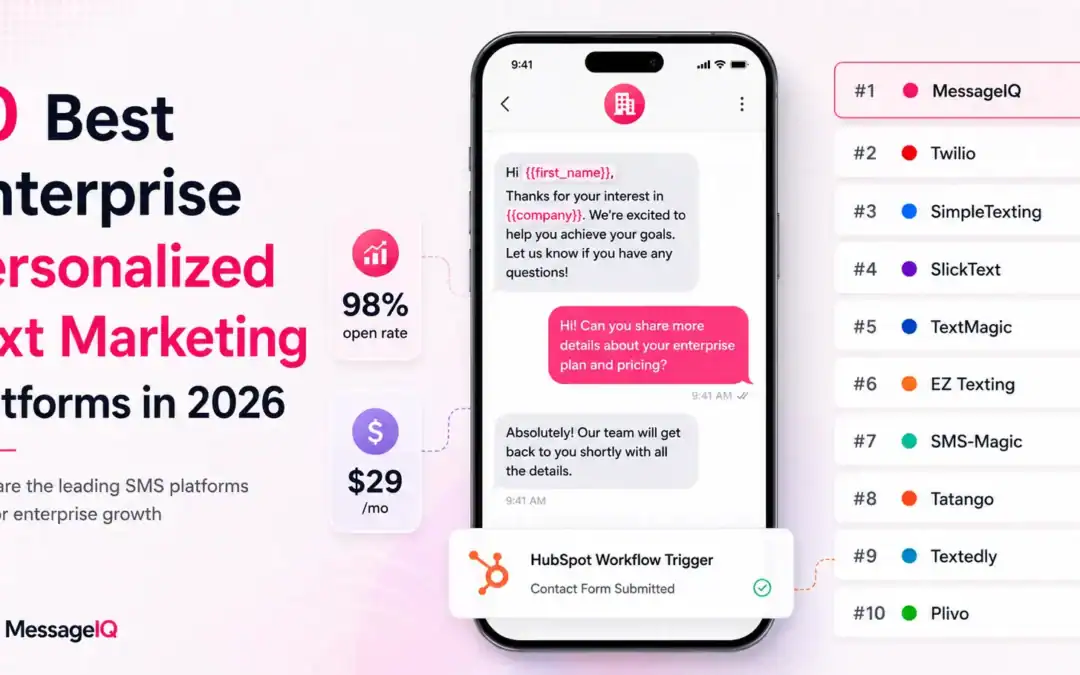
Most enterprise teams treat “personalized SMS” as a first-name token dropped into a broadcast blast. That’s not personalization. That’s a mail merge with a phone number, and your customers can tell the difference.

HubSpot SMS marketing software. Every text logged to the contact record.
Message IQ runs inside HubSpot, not next to it. Workflows trigger the send, replies land in the timeline, and your team never leaves the CRM.
- Free 15-minute strategy call, live demo inside your CRM
- 300+ SMS templates, instant download
- No pitch, no pressure
Plans from $49/mo. Setup and 10DLC registration handled for you.
98% of SMS messages are opened vs roughly 20% for email – but that open rate advantage disappears fast when the message reads like it was written for no one in particular. The teams winning with SMS right now are the ones using CRM data, behavioral triggers, and lifecycle signals to send texts that arrive at the right moment with the right context. Platforms that make that possible at enterprise scale are what this post is about.
We’ve evaluated 10 enterprise personalized text marketing platforms on four criteria: how deep the personalization actually goes, how tightly it connects to your CRM, how the compliance infrastructure holds up, and what it costs to get started.
What Makes a Text Marketing Platform Truly “Enterprise-Grade”?
An enterprise personalized text marketing platform does more than send high volumes of texts. It pulls live CRM data into every message, triggers sends based on real contact activity, routes replies into a shared inbox that your whole team can act on, and maintains an auditable record of every conversation.
The platforms worth evaluating share these five traits:
- Personalization from CRM data, not just static lists. Contact properties, deal stages, lifecycle stages, and custom fields all usable as message variables.
- Behavioral and event-based triggers. Messages fire when something happens – a form submission, a deal stage change, a missed appointment – not just on a schedule.
- Two-way by default. Replies come back to a shared team inbox, not into a void. Every response is logged against the contact record.
- Compliance infrastructure baked in. Opt-out handling, 10DLC registration, and TCPA consent management built into the platform, not bolted on later.
- Revenue-connected analytics. Delivery rates and click-throughs tied to pipeline outcomes, not just message volume.
Quick Comparison: 10 Enterprise Personalized Text Marketing Platforms
| Platform | Best For | Personalization Depth | CRM Integration | Starting Price |
| MessageIQ | HubSpot-native enterprise SMS | High – HubSpot tokens, Active Lists, lifecycle triggers | CRM-native (no middleware) | $99/mo |
| Attentive | Enterprise ecommerce / DTC | High – AI-driven behavioral triggers | API + native connectors | Custom |
| Salesmsg | B2B sales team outreach | Moderate – CRM merge fields, sequences | HubSpot, Pipedrive, Zoho | $25/mo |
| Twilio | Developer-built custom SMS | Unlimited – fully custom code | Any CRM via API | Pay-per-message |
| Braze | Multi-channel enterprise engagement | Very high – liquid templating, real-time data | API / custom | Custom |
| Klaviyo | Ecommerce DTC brands | High – purchase history, browse behavior | Shopify-native | $45/mo |
| Textline | Enterprise customer support | Moderate – tags, segments, routing | Zapier, HubSpot | $27/mo |
| SlickText | Franchise and retail chains | Moderate – keyword and location segmentation | HubSpot, Shopify | $29/mo |
| Salesforce Marketing Cloud | Full-stack enterprise on Salesforce | High – Einstein AI, journey orchestration | Salesforce-native | Custom |
| SimpleTexting | Teams scaling toward enterprise | Basic – merge fields, segments | Zapier, HubSpot | $39/mo |
The 10 Best Enterprise Personalized Text Marketing Platforms in 2026
1. MessageIQ – Best Enterprise Personalized Text Marketing Platform for HubSpot Teams
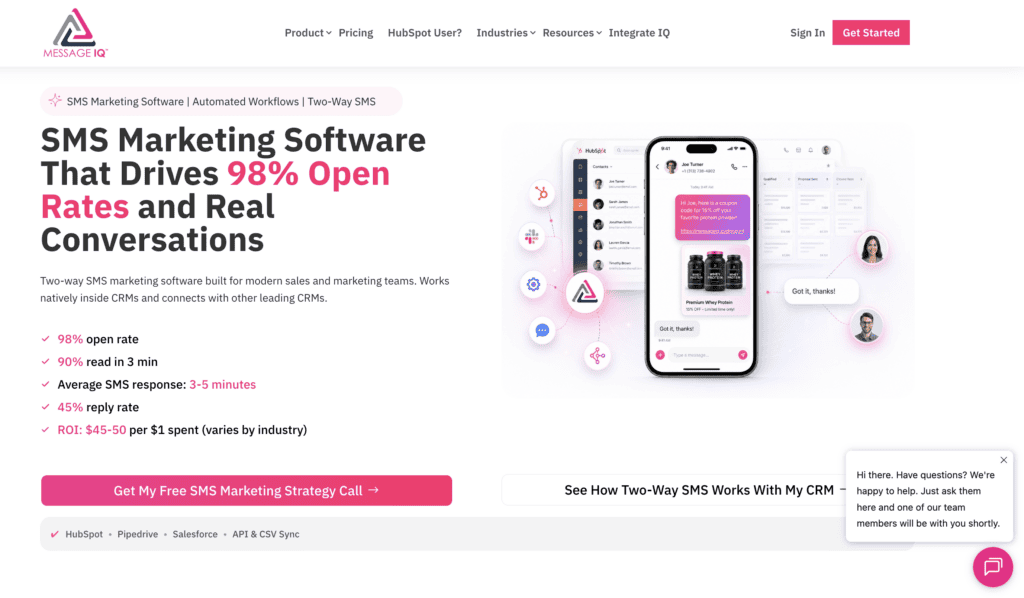
MessageIQ is the only SMS platform on this list built CRM-native inside HubSpot. Every other tool connects to HubSpot through a data bridge. MessageIQ lives inside it – workflow actions, contact record widgets, Active List audiences, and opt-out properties all function as native HubSpot objects.
That architecture matters for personalization. When your SMS platform reads from the same contact record your sales team manages, every message can include live HubSpot data: lifecycle stage, deal name, last activity date, rep name, custom properties. You’re not syncing data across platforms and hoping it’s current. The token renders from the actual record at send time.
MessageIQ’s HubSpot SMS integration also handles the scale problem most enterprise teams hit. IQ Autoscaling lets you grow from hundreds to hundreds of thousands of messages per month on a single business number, so your customers always recognize who’s texting them. IQ Advanced Delivery gives you carrier-level confirmation that messages reached the phone, not just “sent” status.
Built by IntegrateIQ, a HubSpot Diamond Solutions Partner with 275+ platform integrations delivered. Two-way messaging is on by default – every conversation is two-way.
Key personalization capabilities:
- HubSpot contact properties as SMS tokens ({{contact.firstname}}, {{contact.company}}, any custom property)
- Active Lists and static lists as SMS audiences
- Lifecycle stage changes, deal stage moves, and form submissions as enrollment triggers
- Opt-out syncs back to a HubSpot contact property, usable as suppression criteria in any workflow
Best for: B2B sales teams, real estate agencies, healthcare practices, auto glass businesses, schools – any organization running HubSpot that needs SMS to feel like a natural extension of the CRM, not a separate tool.
Pricing: Plans from $49/mo. Every feature ships on every plan – no gated functionality, no “talk to sales to unlock this.”
2. Attentive – Best for Enterprise Ecommerce Personalization
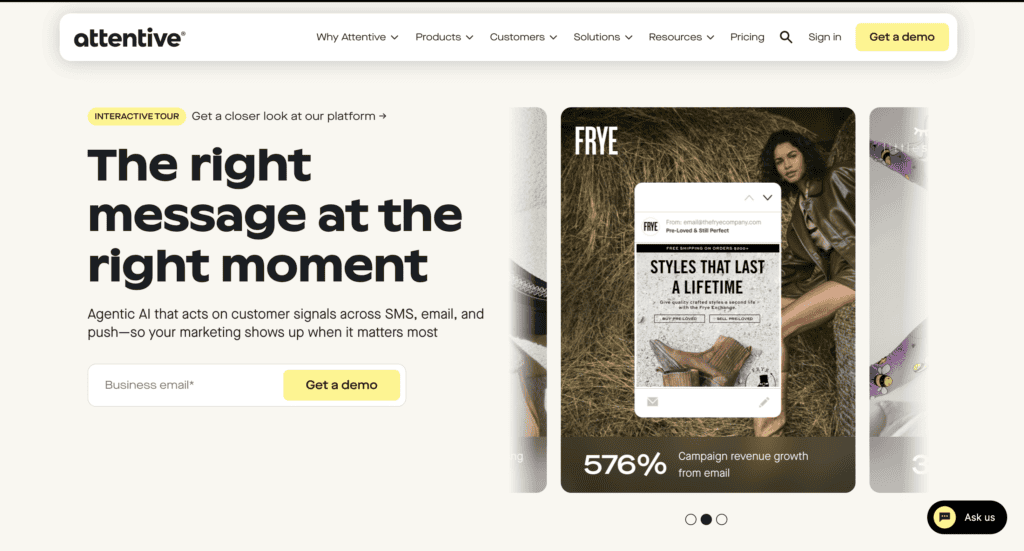
Attentive is the platform that made AI-driven SMS personalization a real thing at enterprise scale for retail and DTC brands. Its AI Journeys module builds triggered message flows from behavioral data – cart abandonment, post-purchase sequences, browse abandonment, win-back campaigns – and optimizes send timing and content automatically.
The patented two-tap opt-in process reduces friction on mobile while keeping consent collection clean, which matters when you’re building a list of millions. Attentive integrates with Shopify, Salesforce, Klaviyo, and 150+ other platforms.
Key personalization capabilities:
- AI Pro: optimizes send time and message content based on individual behavior
- AI Grow: identifies high-intent subscribers and personalizes acquisition flows
- AI Journeys: hyper-personalized triggered sequences from real purchase and browse data
Best for: Mid-market to large ecommerce brands that want SMS to drive a measurable percentage of revenue, not just support other channels.
Watch out: Pricing is custom and enterprise-contract based. Not the right fit for teams that need predictable monthly costs or aren’t running a primarily ecommerce model.
External reference: Attentive’s AI marketing platform
3. Salesmsg – Best for B2B Sales Team Outreach
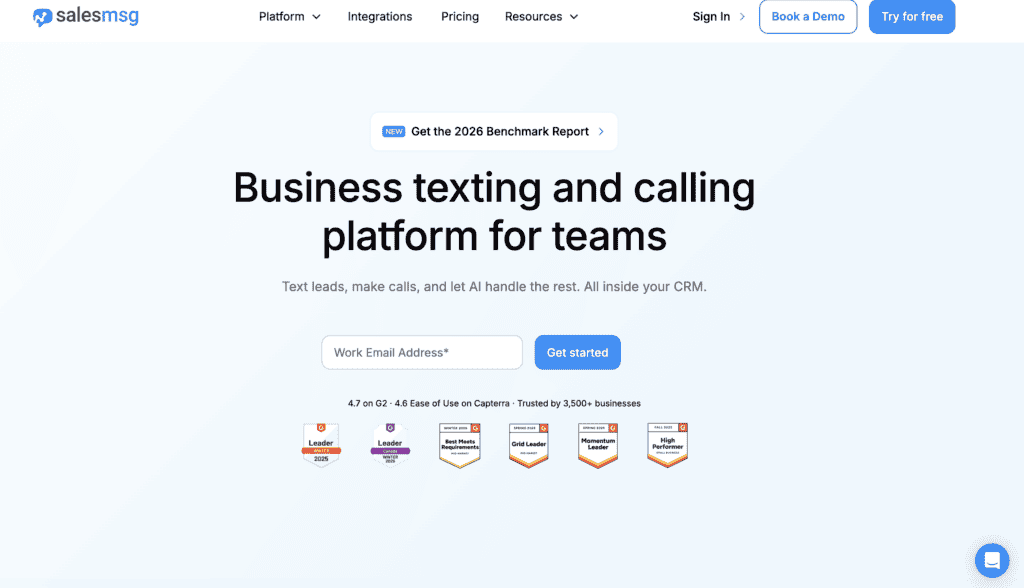
Salesmsg sits at the intersection of conversational SMS and CRM-driven outreach. It’s built for B2B sales reps who need to text prospects from inside HubSpot, Pipedrive, or Zoho without switching tools. You can trigger SMS sequences from CRM activity, use merge fields from contact records, and manage replies in a shared inbox alongside your email conversations.
Local presence numbers let reps text from area codes that match their prospects, which meaningfully improves answer and reply rates in outbound contexts.
Key personalization capabilities:
- CRM merge fields across all major platforms
- Webhook-triggered sequences based on CRM activity
- HubSpot workflow integration for automated follow-up
Best for: SDR and AE teams running high-volume outbound who want SMS as a sequence step alongside email, not as a standalone channel.
Pricing: From $25/mo. Volume-based plans available.
External reference: Zapier’s 2026 SMS platform roundup covers Salesmsg alongside other CRM-connected options.
4. Twilio – Best for Developer-Built Custom Personalization
If your engineering team has the bandwidth and your use case has requirements no off-the-shelf platform covers, Twilio is the right answer. It’s an API-first communications platform – you build exactly what you need, personalize to any depth your data supports, and connect it to any CRM or data warehouse in your stack.
Twilio Studio gives non-developers a no-code flow builder for simpler use cases. Segment, Twilio’s customer data platform, pipes behavioral data directly into messaging flows.
Key personalization capabilities:
- Fully custom – any data you can pass to the API becomes a personalization variable
- Segment CDP integration for real-time behavioral triggers
- Studio for no-code flows when you don’t need custom development
Best for: Engineering-led enterprises with specific compliance, data residency, or workflow requirements that packaged platforms can’t meet.
Watch out: Twilio requires dev resources to set up and maintain. It’s not a marketing team tool. If you want to launch a workflow next week, this isn’t your path.
Pricing: ~$0.0079/SMS sent. Dedicated phone numbers from $1.15/mo. Costs scale with volume.
External reference: Twilio’s programmable SMS documentation
5. Braze – Best for Multi-Channel Enterprise Personalization
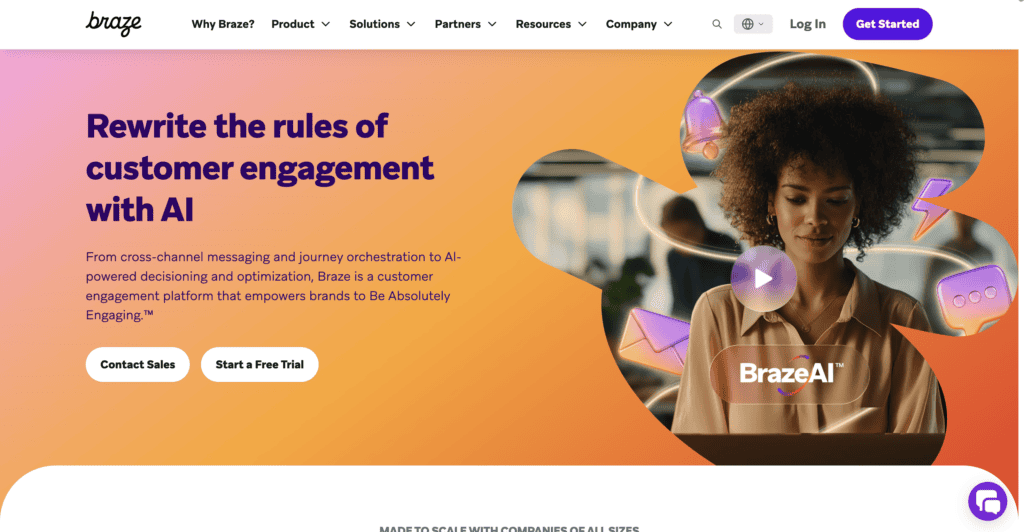
Braze is what you reach for when SMS is one piece of a broader customer engagement architecture that includes push notifications, in-app messaging, email, and web. Its connected content feature pulls live data from external APIs into messages at send time, and liquid templating gives marketers granular control over message content per segment.
The Canvas journey builder orchestrates multi-step, multi-channel sequences where SMS plays a specific role – urgent alerts, time-sensitive offers, re-engagement pings – while email and push handle the rest.
Key personalization capabilities:
- Liquid templating for conditional content within a single message
- Connected content for real-time data pulls from external sources at send
- Predictive suite: churn probability, event likelihood, send time optimization
- A/B and multivariate testing at scale
Best for: Large enterprises already investing in omnichannel engagement who need SMS to coordinate with every other touchpoint, not operate independently.
Watch out: Braze is a significant platform investment – implementation requires dedicated resources and usually a partner agency. It’s overkill if SMS is your only channel.
External reference: Braze customer engagement platform
6. Klaviyo – Best for Ecommerce Behavior-Triggered SMS
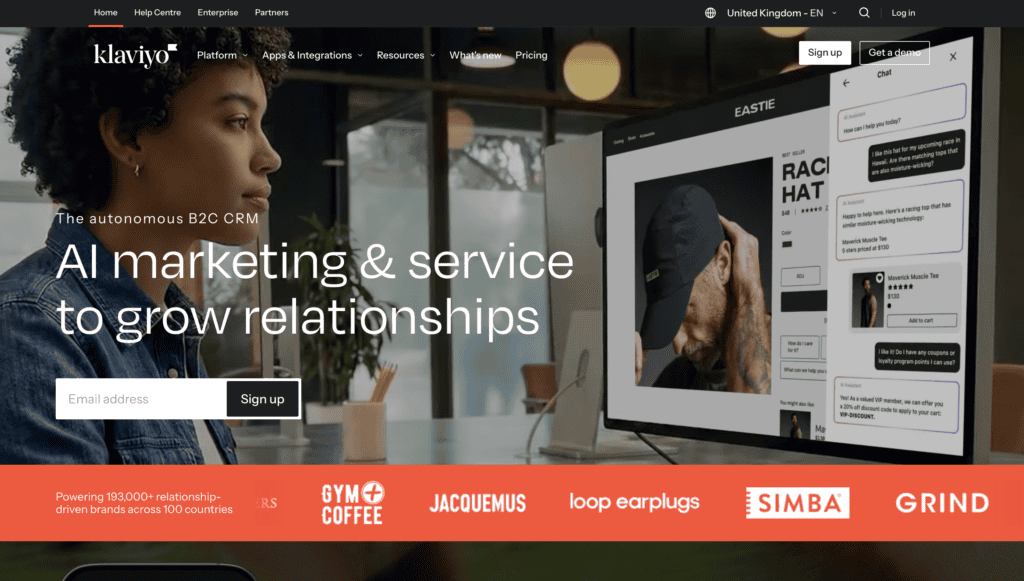
Klaviyo built its reputation on email marketing for ecommerce, and its SMS product inherits the same strength: behavioral data from Shopify, WooCommerce, and BigCommerce drives everything. Purchase history, predicted CLV, product category affinity, and browse behavior all feed into SMS flows without any manual segmentation work.
The Flows builder handles the standard ecommerce automation stack – welcome series, abandoned cart, post-purchase, win-back – with SMS and email coordinated in the same sequence.
Key personalization capabilities:
- Purchase and browse behavior as trigger conditions and message variables
- Predictive CLV segmentation for high-value contact targeting
- Coordinated email + SMS in single flows with shared suppression lists
Best for: DTC and ecommerce brands on Shopify that want email and SMS managed from one platform with a shared data layer.
Watch out: Klaviyo is deep in the ecommerce stack. If your business model doesn’t center on Shopify or WooCommerce, the personalization advantages thin out quickly.
Pricing: From $45/mo (includes both email and SMS).
External reference: Klaviyo’s SMS marketing features
7. Textline – Best for Enterprise Customer Support Teams
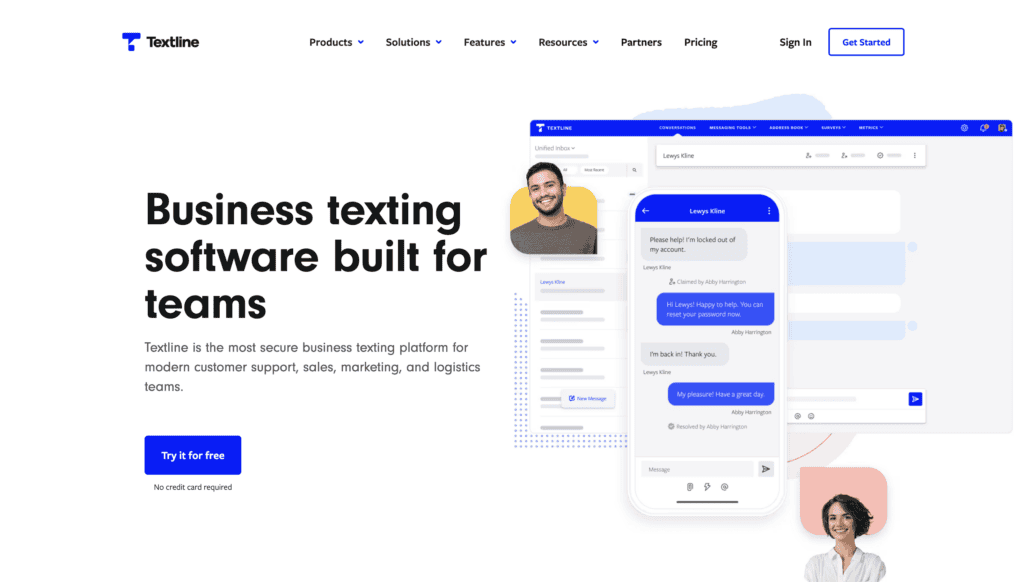
Textline approaches SMS from the support side of the house. It’s built for teams handling high volumes of inbound text conversations – routing, tagging, department assignment, internal notes, and SLA tracking all built into the inbox. HIPAA compliance makes it viable for healthcare businesses that need to text patients about appointments or care instructions without creating a compliance liability.
The personalization model is more reactive than proactive: you segment contacts with tags and departments, route conversations to the right rep, and use automated first responses to acknowledge inbound texts immediately.
Key personalization capabilities:
- Department-based routing for different contact types or inquiry categories
- Tags and segments for audience management
- HIPAA, CCPA, and GDPR compliance for regulated industries
- Auto-responders for after-hours coverage
Best for: Enterprise customer support teams and healthcare businesses where the primary SMS use case is managing inbound conversations, not running outbound campaigns.
For healthcare teams specifically, managing patient communication over SMS requires a platform built for that compliance environment.MessageIQ’s healthcare SMS setup covers how HIPAA-adjacent workflows run inside HubSpot for medical and wellness businesses.
Pricing: From $27/mo. Per-message charges apply.
8. SlickText – Best for Franchise and Retail Chains
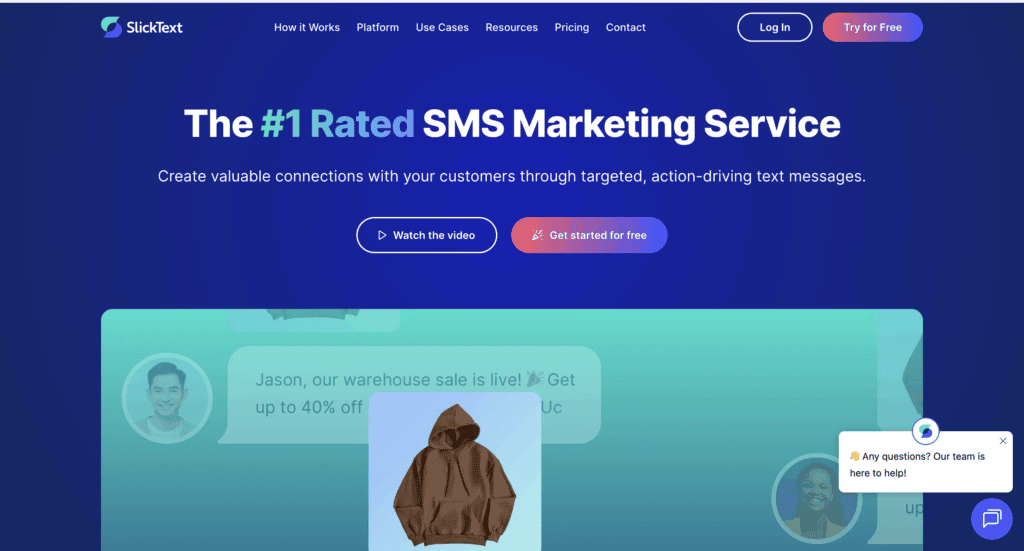
SlickText is built for businesses that operate across multiple locations and need centralized SMS management with location-level flexibility. Franchises and restaurant groups use it to run national promotions while individual locations handle local follow-up. The list growth tools – keyword opt-ins, QR codes, website popups, loyalty integrations – make it strong for consumer-facing brands with large subscriber lists.
HubSpot and Shopify integrations are available but connector-based, not native. That’s workable for retail use cases where the CRM isn’t driving every send.
Key personalization capabilities:
- Keyword and location-based segmentation
- Behavior-based retargeting from engagement history
- AI-powered messaging recommendations for campaign optimization
- Native Shopify and HubSpot connectors
Best for: Multi-location franchises, restaurants, and retail brands where subscriber list growth and broadcast personalization matter more than deep CRM integration.
Pricing: From $49/mo. Volume tiers available.
External reference: SlickText’s enterprise automation overview
9. Salesforce Marketing Cloud – Best for Full-Stack Salesforce Enterprises
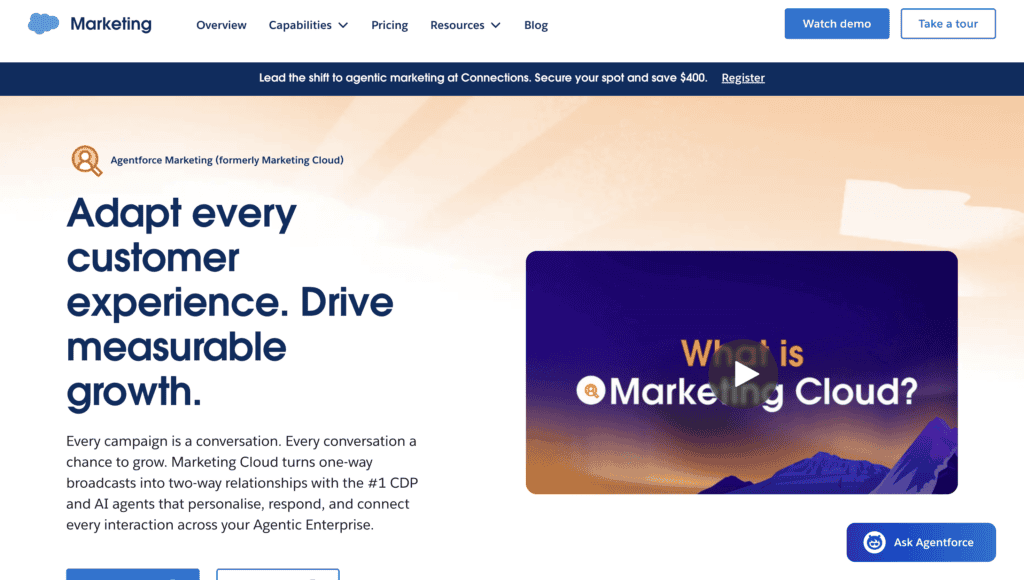
Salesforce Marketing Cloud’s MobileConnect module brings SMS into the broader Salesforce customer engagement architecture. If your enterprise already runs Sales Cloud, Service Cloud, and Data Cloud, adding SMS through Marketing Cloud means every message can draw from the full Salesforce contact and account record, including Einstein AI recommendations, opportunity data, and service case history.
Journey Builder orchestrates multi-step sequences where SMS slots in based on contact behavior – a deal stage change in Sales Cloud triggers an SMS follow-up in Marketing Cloud without any manual intervention or data sync.
Key personalization capabilities:
- Full Salesforce object data as personalization variables (contacts, accounts, opportunities, cases)
- Einstein AI for send time optimization and content recommendations
- Journey Builder for cross-cloud triggered sequences
- Native integration with Sales, Service, and Data Clouds
Best for: Large enterprises already running the full Salesforce stack who want SMS as a coordinated channel alongside every other Salesforce engagement touchpoint.
Watch out: This is a significant contract and a complex implementation. Most teams need a Salesforce partner to configure it correctly. If you’re not already on Salesforce, this isn’t the starting point.
External reference: Salesforce Marketing Cloud overview
10. SimpleTexting – Best Entry Point for Growing Enterprise Teams
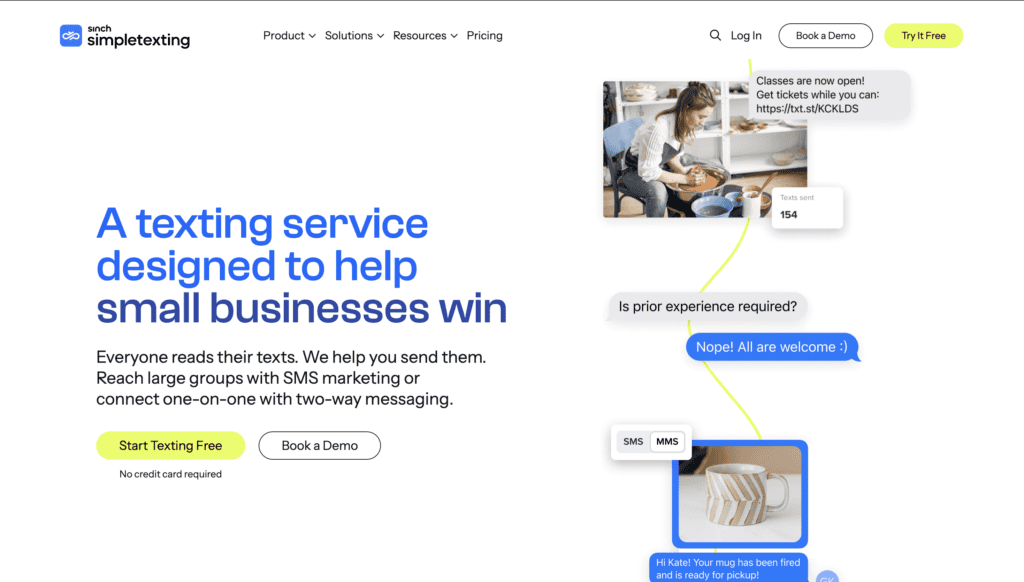
SimpleTexting won’t match the CRM depth or personalization sophistication of the other platforms on this list, but it earns its place for teams that need reliable SMS capabilities today without a complex implementation. The UI is genuinely easy to use, the HubSpot connector works for basic sync, and the two-way messaging inbox handles moderate reply volumes without issues.
Key personalization capabilities:
- Merge fields for contact data in campaign messages
- Segment-based sends by contact list or tag
- Auto-responder sequences for basic drip follow-up
Best for: Teams actively scaling from mid-market toward enterprise who need SMS running this quarter without a procurement cycle, with plans to migrate to a deeper platform as complexity grows.
Watch out: Personalization is limited to static merge fields. There are no behavioral triggers, no CRM-native architecture, and no deep workflow integration. It works until you need more.
Pricing: From $39/mo.
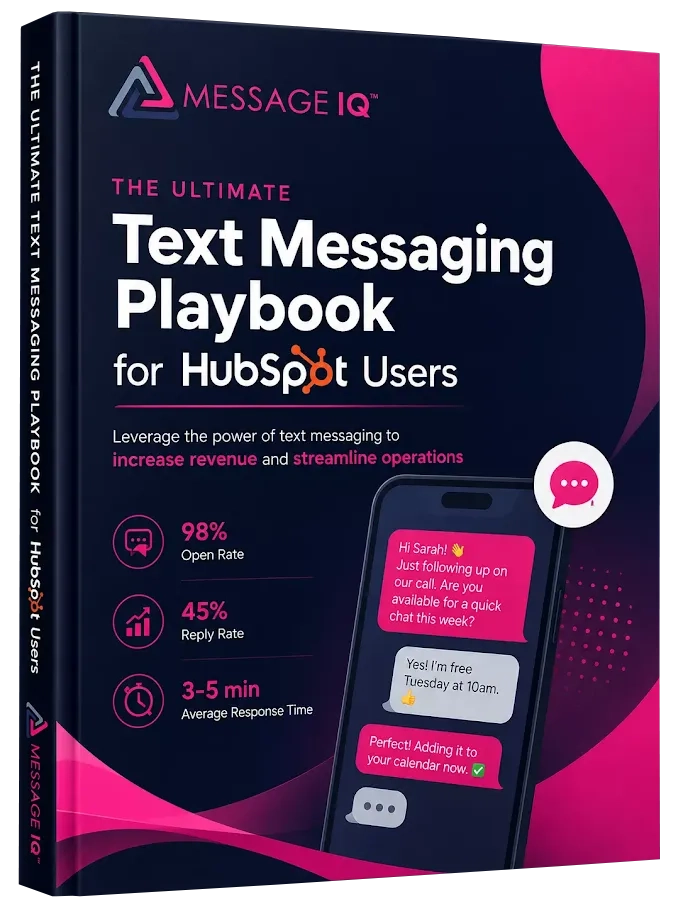
Get Your Ultimate HubSpot Text Messaging Playbook for FREE
Discover how top HubSpot teams use SMS to boost engagement, close deals faster and streamline operations.
Instant download
Expert insights from certified HubSpot professionals
Ultimate Text Messaging Playbook
How to Choose the Right Enterprise Personalized Text Marketing Platform
Start with your CRM
The platform that personalizes best is the one that reads your contact data directly. If you’re running HubSpot, the most natural choice is a platform that lives inside HubSpot rather than connecting to it. MessageIQ is built specifically for HubSpot teams who want SMS to behave like a native feature, not an integration to manage.
If you’re on Salesforce, Marketing Cloud is the obvious fit. Twilio or Braze works for teams with multiple CRMs or custom data architectures.
Match the platform to your primary use case
The platforms on this list solve different problems:
- Outbound sales and speed-to-lead: MessageIQ, Salesmsg
- E-commerce revenue from behavioral triggers: Attentive, Klaviyo
- Enterprise omnichannel customer engagement: Braze, Salesforce Marketing Cloud
- Inbound customer support: Textline
- Multi-location franchise management: SlickText
- Custom infrastructure, dev-led builds: Twilio
Real estate teams using HubSpot to manage buyer and seller pipelines run very different workflows than healthcare practices sending appointment reminders. Real estate agencies need speed-to-lead triggers and deal stage personalization. Education teams need enrollment status triggers and parent communication flows. The right platform connects to how your business actually works.
Check compliance before you commit
Every platform on this list claims TCPA compliance. What you want to verify is whether opt-out handling is automatic and whether it writes back to your CRM in a way you can use as a suppression filter. If someone texts STOP and that doesn’t instantly prevent them from receiving another message through any workflow in your system, you have a compliance gap.
Also confirm 10DLC registration support. A2P 10-digit long code registration is required for business texting in the US, and carriers actively block unregistered traffic. Platforms that handle brand and campaign registration as part of onboarding save you weeks of friction.
Evaluate personalization depth, not feature count
A long feature list isn’t personalization. Ask these specific questions:
- Can I use custom CRM properties as message variables, or just first name and company?
- Do triggers fire from real CRM events, or only from scheduled sends?
- Does a reply from a contact update their CRM record automatically?
- Can I suppress contacts from a workflow based on a property change mid-sequence?
If the answers are yes, the platform is doing real personalization. If the answers are “that requires an API call” or “you’d use Zapier for that,” you’re looking at a tool built for simpler use cases.
SMS vs. Email for Enterprise Personalized Marketing
| SMS | ||
| Open rate | ~98% | ~20% |
| Read within 3 minutes | 90%+ | Rarely |
| Average response time | 3 to 5 minutes | Hours to days |
| Personalization options | CRM tokens, behavioral triggers, lifecycle stage | Same options, lower urgency |
| Best use | Time-sensitive, high-priority, response-required | Nurture sequences, long-form content, confirmations |
| Compliance requirement | TCPA opt-in, 10DLC registration | CAN-SPAM |
| Two-way by default? | Yes (on the right platform) | No |
SMS and email aren’t competing for the same job. SMS wins when a message needs to be seen and acted on fast. Email wins when content depth matters more than immediacy. The enterprise teams getting the most out of SMS are the ones who’ve stopped treating it as a cheaper email replacement and started using it for what it’s actually good at. For a direct comparison of how the two channels perform inside HubSpot, this breakdown of SMS vs. email for HubSpot teams covers the handoff points in detail.
FAQ
What is an enterprise personalized text marketing platform?
An enterprise personalized text marketing platform is a business SMS tool built to send individually tailored messages at scale, using CRM data, behavioral triggers, and contact properties to personalize each text. Unlike bulk SMS tools, enterprise platforms connect directly to your CRM, log every conversation, and support team-based workflows with compliance controls built in.
How does SMS personalization work at enterprise scale?
At enterprise scale, SMS personalization works by pulling live CRM data – contact name, company, lifecycle stage, deal stage, or custom properties – into message templates as dynamic tokens. Platforms like MessageIQ render HubSpot contact properties directly inside SMS workflows, so a message sent to 5,000 contacts still reads like a 1:1 conversation. The key difference from basic merge-field personalization is that enterprise platforms trigger sends from real contact events, not just static send schedules.
Which SMS platform integrates best with HubSpot?
MessageIQ integrates most deeply with HubSpot because it’s built CRM-native, not connected through a third-party bridge. Workflow actions, contact record widgets, Active List triggers, and opt-out properties all live inside HubSpot natively. Most other SMS tools push data back into HubSpot via a connector, which creates sync delays and limits what you can trigger. If HubSpot is your CRM, a native integration will always outperform a connected one for personalization use cases.
Do enterprise text marketing platforms handle TCPA compliance automatically?
The better platforms do. MessageIQ automatically updates an opt-out property on the HubSpot contact record when someone replies STOP, UNSUBSCRIBE, QUIT, or CANCEL, and that property functions as a suppression filter across every workflow. 10DLC brand and campaign registration is handled at setup with white-glove support. Platforms that don’t handle registration as part of onboarding leave you responsible for navigating carrier requirements on your own, which is where most compliance problems start.
What’s the difference between a personalized text marketing platform and a bulk SMS tool?
A bulk SMS tool sends the same message to a large list. A personalized text marketing platform uses CRM data, behavioral signals, and contact properties to tailor every message individually, even at high volume. The output looks different to every recipient, triggers are based on real contact activity, and replies flow back into a shared team inbox connected to your CRM. Bulk tools are designed for broadcast. Personalized platforms are designed for conversation.
How much does an enterprise text marketing platform cost?
Pricing varies significantly by platform and use case. MessageIQ starts at $49/mo with every feature included on every plan – no gated functionality. Platforms like Attentive, Braze, and Salesforce Marketing Cloud are custom-priced enterprise contracts that typically start in the thousands per month. Developer-first platforms like Twilio charge per message, which scales predictably with volume. For a full breakdown of what MessageIQ plans include at each tier, the pricing page covers it without the “contact sales” friction.
See how much revenue SMS could add to your HubSpot stack
Five inputs. Industry-backed benchmarks. Get your projected annual SMS revenue in under 30 seconds.
Calculate My SMS ROI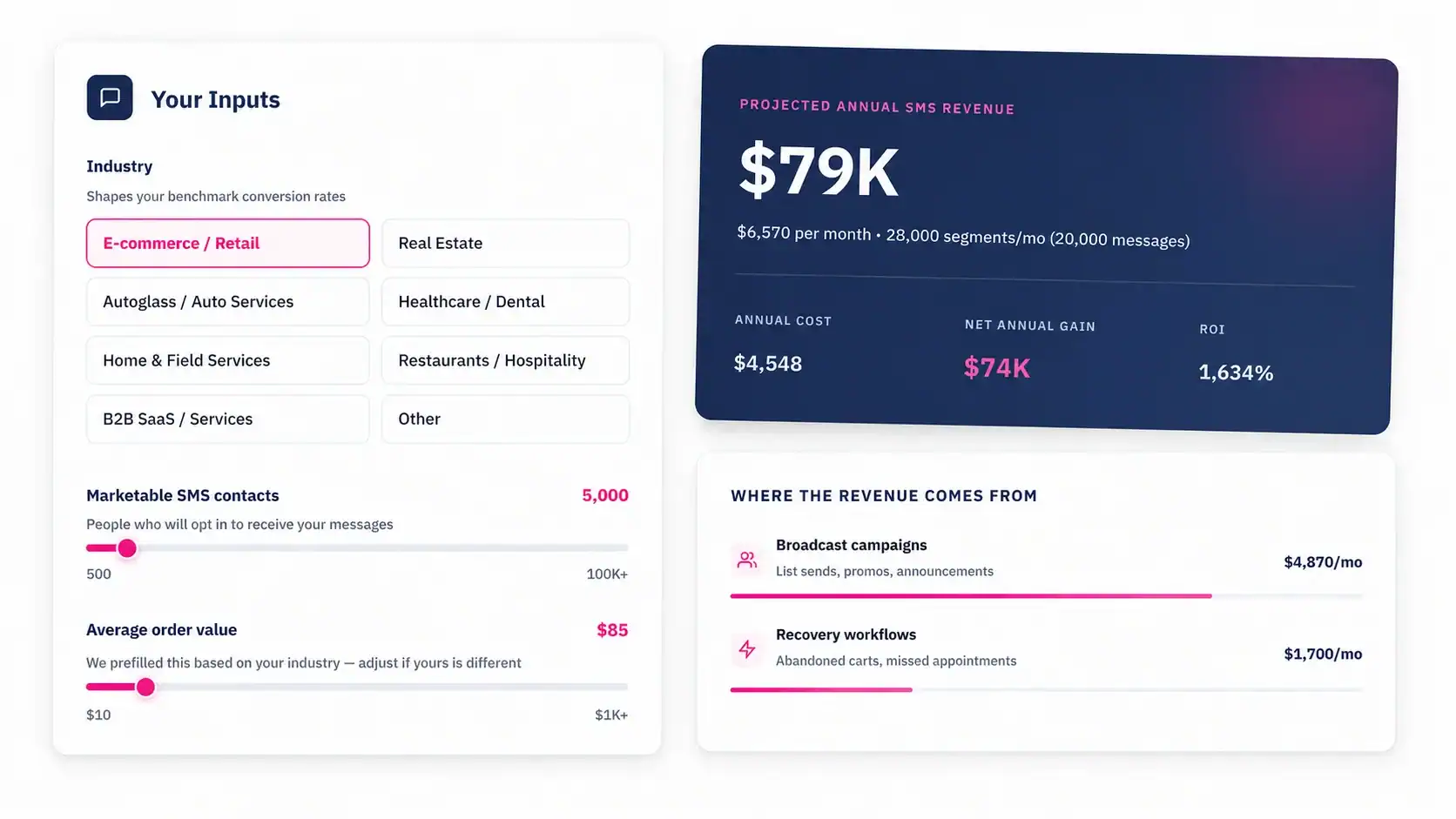
Stop Sending Blasts. Start Sending Texts That Actually Land.
Your contacts already ignore broadcast emails. They’re starting to ignore broadcast texts too. The teams building real pipeline from SMS in 2026 are the ones where every message feels like it came from someone who knows the contact – because the platform reads from the same CRM data the sales team does.
If your stack runs on HubSpot, Message IQ connects in minutes and your first personalized workflow can be live before the end of the day. Plans start at $49/mo with no feature gating and no long-term contracts. See how MessageIQ runs inside HubSpot and decide if it fits how your team works.