

98% of SMS messages get opened. It’s the most repeated stat in business texting and it’s also the most misunderstood one. That number describes structural visibility, not active reading. A message that expands on a lock screen counts as ‘opened’ the same way a message someone reads word-for-word and replies to does.
That doesn’t make it useless. SMS open rates genuinely demolish email’s 20–28%. The channel earns the stat. But if you’re trying to build an SMS program that drives revenue speed-to-lead follow-ups, appointment reminders, HubSpot workflow automation you need to understand what open rate actually tells you, what it doesn’t, and which metrics are worth tracking instead.
This article gives you the 2026 SMS open rate benchmarks, the honest context behind them, industry-level data, the full comparison against email, and a practical breakdown of how Message IQ connects SMS performance data directly to HubSpot contact and deal records so you can track what actually moves the needle.
Message IQ – Sending SMS from HubSpot
What Is SMS Open Rate?
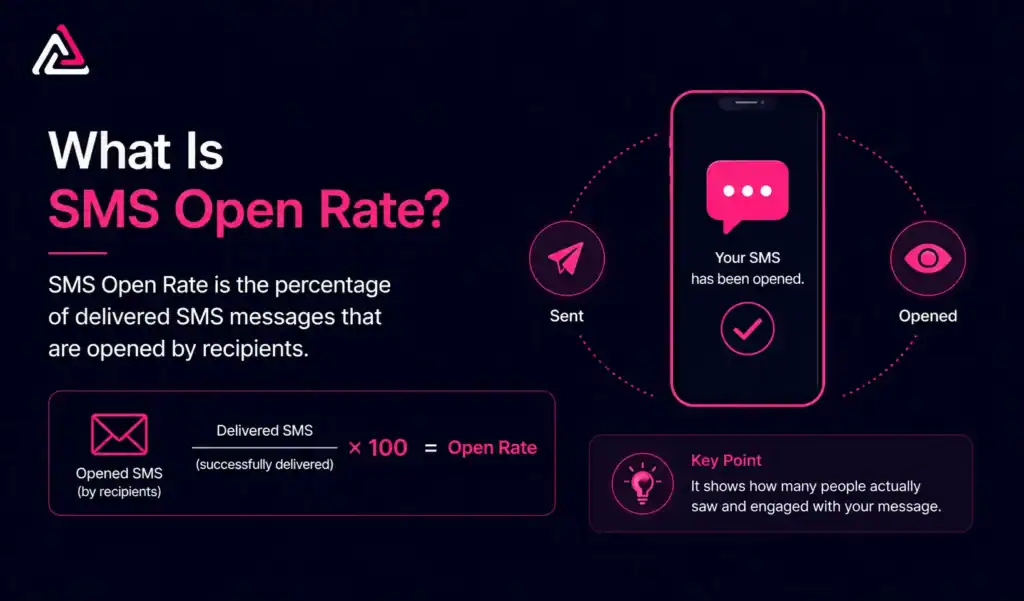
SMS open rate is the percentage of delivered text messages that recipients open and read out of the total sent in a campaign. If you send 1,000 SMS messages and 970 are opened, your open rate is 97%. Industry consensus places the average across all business SMS use cases at 95–98%, with the widely cited 98% figure representing the upper range of opt-in marketing campaigns.
One important technical note: SMS doesn’t have a tracking pixel equivalent. Email ‘opens’ are measured when a 1×1 pixel image loads in the message body. SMS has no such mechanism. The 95–98% figure is estimated from delivery confirmation data, response behavior, and lock-screen expansion analytics not direct measurement. The number is real, but it’s an informed estimate rather than a precisely instrumented metric. That’s also why CTR, reply rate, and conversion data tend to be more actionable for optimizing SMS programs.
SMS Open Rate Benchmarks for 2026
Here’s where the data settles across the major benchmarking sources Klaviyo SMS benchmarks, Attentive’s State of SMS report, Postscript annual data, Twilio Customer Engagement Report and Validity deliverability research:
- Overall SMS open rate: 95–98% (benchmark average 98% for opt-in marketing campaigns)
- Messages read within 3 minutes of delivery: 90%
- Messages read within 5 minutes: 82%
- Messages read within 60 seconds: 32%
- Delivery rate for 10DLC-registered brands: 96.8% (Tier 1 carriers Verizon, AT&T, T-Mobile deliver above 97.4% for vetted senders)
- Delivery rate for unregistered traffic: closer to 92% and declining as carriers tighten filtering
The speed data matters more than the percentage for B2B use cases. A lead who fills out a HubSpot form and gets an SMS within 90 seconds is 21 times more likely to qualify than one followed up after 30 minutes. The 90% read-within-3-minutes figure is why Message IQ’s speed-to-lead workflow form fill triggers SMS in under 10 seconds consistently outperforms email follow-up sequences on first-response rate.
SMS Open Rate vs. Email Open Rate: Full Benchmark Comparison
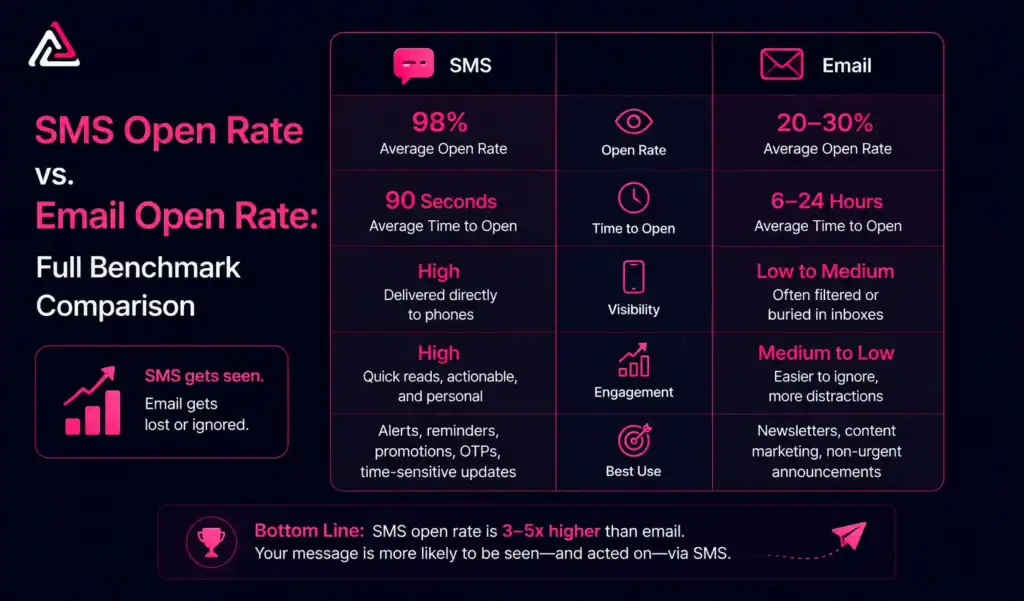
The headline comparison is 98% vs. 20%. But the full picture is more nuanced and more useful for deciding when to use each channel.
| Metric | SMS | |
| Open rate | 95–98% | 20–28% |
| Read within 3 minutes | 90% | ~10% |
| Response / reply rate | 45% | 6% |
| Click-through rate (CTR) | 19–20% | 2–4% |
| Conversion rate (campaigns) | 21–32% | 2–5% |
| Opt-out rate per send | Under 3% | 0.1–0.5% unsubscribe |
| Delivery rate (registered) | 96.8% | ~85% (inbox placement) |
| ROI per $1 spent | $4–$71 (varies by use case) | $36–$45 |
Why Email Open Rate Is Also a Somewhat Misleading Metric
Email open rates have their own measurement problem. They depend on a tracking pixel loading and Apple’s Mail Privacy Protection pre-fetches that pixel for many iOS users, inflating opens. Other privacy tools block the pixel entirely, hiding genuine opens. The result: email’s reported 20–28% open rate is simultaneously overstated for privacy-protected users and understated for others. The true read engagement rate is harder to measure than the reported number suggests.
SMS doesn’t have this problem. There’s no privacy-protection layer that intercepts a text message before it reaches the recipient. What lands, lands which is a structural advantage that the open rate stat only partially captures.
When Email Still Wins
SMS open rates dominate on speed and visibility. Email wins on content depth, cost at scale, and nurture sequences where the reader needs time to consider. The right model uses both SMS for time-sensitive, high-intent moments (form fills, appointment reminders, deal-stage follow-ups), email for longer-form content and multi-touch nurture. Message IQ running inside HubSpot lets you coordinate both channels from the same CRM workflow, seeing SMS and email engagement history on the same contact timeline.
SMS Open Rates by Industry (2026)
Open rate variation across industries is smaller for SMS than for email texts land in the same personal inbox regardless of sector. The more meaningful industry differences show up in CTR, reply rate, and conversion. Here’s the current benchmark picture:
| Industry | Open Rate Range | CTR Benchmark | Primary SMS Use Case |
| Retail / Ecommerce | 97–99% | 19–26% | Flash sales, cart recovery, loyalty |
| Healthcare | 95–98% | Low CTR, high action rate | Appointment reminders, care gap alerts |
| Financial Services | 94–97% | 20%+ | Transaction alerts, fraud notifications, offers |
| Hospitality / Travel | 95–97% | 18–22% | Booking confirmations, check-in reminders |
| B2B SaaS / Professional | 94–97% | 15–20% | Speed-to-lead, demo follow-ups, renewals |
| Auto Glass / Home Services | 95–98% | 20–25% | Job confirmations, arrival alerts, reviews |
| Food & Beverage | 95–98% | 18–22% | Promos, reservations, loyalty rewards |
Why Industry Differences Are Smaller for SMS Than Email
Email open rates swing dramatically by industry. Healthcare emails hit 28–36% while retail promotional emails average 18–26%, largely because spam filter placement and inbox competition vary so much by sector. SMS doesn’t have this problem texts bypass spam folders entirely and land in the same personal inbox whether you’re a healthcare provider or a SaaS company. The structural advantage is consistent. Where industries differ is in what recipients do after opening: B2B contacts tend to reply with intent, while ecommerce subscribers tend to click links.
For B2B teams on HubSpot the core Message IQ audience the relevant industry benchmark is the B2B SaaS / Professional Services row: 94–97% open rate, 15–20% CTR, with the highest-value signal being reply rate. A deal-stage SMS that gets a reply is worth far more than one that gets a link click and a 3-second page visit.
The Metrics That Actually Matter Beyond SMS Open Rate
Open rate tells you messages are being seen. These six metrics tell you whether your SMS program is working:
| Metric | What It Measures | Why It Matters More Than Open Rate |
| CTR (click-through rate) | % of recipients who tap a link | Measures real engagement, not just delivery |
| Reply rate | % who send a text back | Signals two-way intent the highest-value signal in B2B |
| Opt-out rate per send | % who reply STOP per campaign | Tracks list health and message relevance over time |
| Reply-to-close rate | % of SMS replies that convert to deals (CRM-tracked) | The B2B metric that connects SMS to revenue |
| Revenue per send (RPS) | Revenue attributed to a specific SMS send | True ROI signal automated flows average $3–$11 RPS |
| Delivery rate | % of sent messages that reach the handset | Drops below 93% for unregistered 10DLC traffic |
Reply Rate: The B2B Signal That Open Rate Misses
SMS response rates average 45% across all business use cases, compared to 6% for email. For B2B teams, reply rate is the single most valuable SMS metric more than CTR, more than open rate. A reply signals intent. It puts a real person in a two-way conversation with your sales team. In Message IQ’s shared inbox, that reply goes directly to the rep who owns the contact in HubSpot, with the full conversation thread and contact context visible in one place.
The B2B-specific metric to track is reply-to-close rate: of all the HubSpot contacts who replied to an SMS workflow message, what percentage converted to closed-won deals? This requires an SMS platform that logs replies as CRM activity which is exactly what Message IQ does, writing every inbound text as a note on the HubSpot Contact and Deal timeline.
CTR and Reply Rate by Message Type
Aggregate CTR and reply rate numbers hide most of the useful signal. A program-wide average blends a re-engagement text sent to a dormant contact with a speed-to-lead text sent ninety seconds after a form fill, and those two message types perform nothing alike. Benchmarked by message type instead of averaged across a whole program, the picture lines up with the four Message IQ templates below:
- Speed-to-Lead (Reply CTA): reply rate 50-65%, the highest of any B2B SMS message type, driven by the 90-second trigger window and the direct question format.
- Deal Stage Follow-Up (Link CTA): CTR 20-28% on the proposal link, with an additional 15-20% reply rate from prospects who respond instead of clicking.
- Appointment Reminder (Confirm CTA): confirmation rate 70-85%, among the highest completion signals in B2B SMS because the ask is binary (confirm or reschedule).
- Re-Engagement (Low-friction reply): reply rate 8-15%, the lowest of the four, which is expected for contacts dormant 60+ days rather than a sign the message underperformed.
Use these as directional ranges, not hard targets your own list quality, industry, and message copy will move the numbers. The point is to benchmark each workflow against its own message type, not against the program-wide average.
Opt-Out Rate: The Health Signal Most Teams Ignore
Industry opt-out benchmarks run below 3% per send for well-run programs, with best-in-class programs seeing 0–1.5%. Broken down by frequency, the pattern is consistent: programs sending 1-3 messages a month see opt-out rates near 0.2% per send, 4-6 messages a month sit around 0.3%, 7-9 messages climb to roughly 0.6%, and 10+ messages a month push opt-out above 0.7% per send with monthly cumulative churn over 3%. The warning sign: opt-out rates tend to spike after the second or third message to a new subscriber. High early churn almost always points to an expectation-setting problem at opt-in, not a message quality problem. If contacts didn’t clearly understand they were signing up for marketing SMS when they gave consent, the second message they receive feels like a surprise and they opt out.
The fix: tighten opt-in language on your HubSpot forms to set accurate expectations about message type and frequency. Message IQ captures opt-in timestamps and consent language against the HubSpot contact record, giving you an audit trail and the context to diagnose opt-out spikes by opt-in source.
Get Your Ultimate HubSpot Text Messaging Playbook for FREE
Discover how top HubSpot teams use SMS to boost engagement, close deals faster and streamline operations.
Instant download
Expert insights from certified HubSpot professionals
Ultimate Text Messaging Playbook
How to Improve SMS Performance in HubSpot (Beyond Open Rate)
Open rate for SMS is largely structural; if your number is registered and your list is opted-in, you’ll land in the 95–98% range automatically. The levers that actually move CTR, reply rate, and conversion are these:
1. Lead with your brand name
The first thing a recipient sees is the sender name or number. Messages that open with ‘Hi {{first_name}}, this is Sarah from Message IQ’ get read differently than an anonymous 10-digit number. Consistency in sender identity builds recognition that compounds over time. In Message IQ, you can set a default sender name and pre-configure it as the opening of every template.
2. Send within the right timing window
Peak SMS engagement runs 11 AM–2 PM and 5–7 PM in the recipient’s local time zone on weekdays. Monday and Tuesday outperform Thursday and Friday for B2B contacts. These windows matter less for open rate texts to get opened regardless but they significantly affect reply rate and CTR, because recipients are more likely to act when they’re in work mode. Message IQ’s quiet hours enforcement holds scheduled sends that fall outside the 8 AM–9 PM TCPA window and delivers at the next compliant window automatically.
3. Personalize beyond first name
Personalized SMS messages see roughly 35% higher engagement than generic sends. First name is the minimum. High-performing B2B messages pull deal stage, company name, product interest, or recent activity from HubSpot contact properties into the message body. A message referencing ‘your HubSpot migration project‘ reads completely differently than ‘your recent inquiry.’ Message IQ supports all standard HubSpot merge tags {{contact.firstname}}, {{contact.company}}, {{deal.dealname}}, and any custom property you’ve mapped.
4. Use one CTA per message
Multiple CTAs split attention and reduce action. ‘Reply YES to confirm, or click here to reschedule, or call us at…’ is three CTAs fighting each other. Pick one. Reply-based CTAs tend to outperform link CTAs for B2B sales contexts because they start a conversation. Link CTAs outperform for transactional and ecommerce contexts where the action is a purchase or booking. Test both and let the reply rate data decide.
5. Cap frequency at 4–6 messages per subscriber per 30 days
Postscript benchmark data shows subscriber-level frequency caps of 4–6 messages per month reduce opt-out rates by 28% compared to campaign-level caps at the same total volume. The reason: campaign caps don’t account for contacts who are enrolled in multiple workflows simultaneously. A contact receiving 3 automated sequences plus a broadcast campaign can hit 8+ messages in a week before anyone notices. Message IQ’s HubSpot integration lets you set enrollment suppression logic that prevents over-messaging across workflows.
6. A/B test message copy in HubSpot workflows
HubSpot’s workflow branch logic lets you split-test SMS messages by enrolling 50% of contacts in one workflow branch (Template A) and 50% in another (Template B), then comparing reply rates and CTR from Message IQ’s dashboard. Most teams test opening line, CTA format (reply vs. link), and message length (under 100 characters vs. full 160). Three to four weeks of data at meaningful volume gives you enough signal to pick a winner.
SMS Message Templates That Drive High Engagement
These templates are optimized for reply rate and CTR the metrics that go beyond open rate for B2B teams. All work with Message IQ’s template library and HubSpot merge tags.
Template 1: Speed-to-Lead (Reply CTA)
Hi {{first_name}}, saw you checked out {{company_name}} I’m {{rep_name}}. What’s your biggest challenge with SMS right now? Reply anytime. STOP to opt out.
Target metric: Reply rate. Trigger within 90 seconds of form fill.
Character count: ~140 (single segment)
Template 2: Deal Stage Follow-Up (Link CTA)
Hi {{first_name}}, sent over the proposal yesterday any questions before you loop in the team? Here’s a quick summary: {{link}}. Happy to jump on a call. STOP to opt out.
Target metric: CTR + reply rate. Trigger when deal stage moves to Proposal Sent for 2+ days.
Character count: ~153 (single segment)
Template 3: Appointment Reminder (Confirm CTA)
Hi {{first_name}}, reminder: your call with {{rep_name}} is tomorrow at {{time}}. Reply YES to confirm or RESCHEDULE to change. {{company_name}}. STOP to opt out.
Target metric: Confirmation rate (custom HubSpot property). Trigger 24 hours before the meeting date.
Character count: ~148 (single segment)
Template 4: Re-Engagement (Low-friction reply)
Hey {{first_name}}, it’s {{rep_name}} from {{company_name}} haven’t connected in a while. Still thinking about [use case]? Even a quick ‘yes’ helps. STOP to opt out.
Target metric: Reply rate. Trigger on contacts dormant for 60+ days in HubSpot.
Character count: ~143 (single segment)
Tracking SMS Open Rates and Performance Inside HubSpot
Message IQ logs every SMS interaction sends, deliveries, replies, opt-outs, link clicks directly to the HubSpot Contact timeline. This means your SMS performance data lives in the same place as your email, form, and deal data. Here’s how to build a meaningful performance view:
- Set up a Message IQ Contact property in HubSpot: ‘Last SMS Reply Date.’ Any contact who replies populates this field automatically. This lets you filter for high-engagement SMS contacts across your CRM.
- Create a HubSpot Custom Report: filter by ‘SMS sent in last 30 days’ and segment by ‘SMS replied = true.’ The ratio gives you your effective reply rate a more meaningful signal than open rate alone.
- Build a deal pipeline report filtered by ‘Last SMS Date in last 7 days’ and ‘Deal Stage = Closed Won.’ This surfaces your SMS-to-close correlation the metric that actually justifies the channel to leadership.
- Monitor opt-out rates by list in Message IQ’s dashboard. A spike in a specific segment points to an expectation-setting issue at that segment’s opt-in source. Trace it back to the HubSpot form or workflow that enrolled them.
- Use HubSpot’s A/B workflow branching to test message variants. After 3 weeks at volume, compare branch performance in Message IQ’s send analytics and promote the winner to your primary workflow.
A Note on 10DLC, Delivery Rates, and Why They Affect Your Open Rate
The 95–98% SMS open rate assumes your messages are actually reaching the handset. Unregistered A2P traffic tells a different story: delivery rates for non-10DLC-registered sends sit around 92% and trending lower as Tier 1 carriers tighten filtering in 2026. That 6-percentage-point delivery gap directly reduces your effective open rate messages that never arrive can’t be opened.
After the carrier-wide 10DLC rollout stabilized in 2026, registered brands across Verizon, AT&T, and T-Mobile saw delivery rates above 97.4%. Non-vetted standard tier sends sit closer to 92%. The practical implication: A2P 10DLC registration isn’t just a compliance requirement it’s a delivery optimization. Message IQ handles brand and campaign registration with The Campaign Registry as part of onboarding, so your sends start at the higher delivery tier from day one.
Does RCS Change the SMS Open Rate Story?
Rich Communication Services (RCS) is starting to show up in every 2026 benchmark report, and it matters for how you should read the open rate stat. RCS reached roughly 54% of US smartphones by early 2026, including iPhones after Apple’s iOS 18 interoperability rollout. Unlike standard SMS, RCS includes read receipts, verified sender branding, and rich cards, which means the “opened” event is a real, timestamped signal instead of an estimate built from delivery confirmation and lock-screen analytics.
Early data puts RCS click-through rates at 1.8 to 2.4 times standard SMS for the same audience, with verified-sender messages converting roughly 34% higher. For HubSpot teams thinking ahead, RCS does not replace SMS in 2026. It is a channel to watch for 2027 planning, not one to migrate a working SMS program to yet.
What it does do is strengthen the point this article keeps making: SMS’s 95-98% open rate is a structural, estimated number. RCS is the first messaging format that will give B2B teams something closer to a genuine, measurable open and read event, once adoption clears the threshold where you can build a program around it rather than a pilot. Message IQ customers on HubSpot should treat SMS as the reliable channel to run today and RCS as the next one to test small, not the one to bet the program on.
Frequently Asked Questions
What is the average SMS open rate?
The average SMS open rate across business use cases is 95–98%, with the widely cited 98% figure representing the upper range of opt-in marketing campaigns. Industry benchmarks from Klaviyo, Attentive, Postscript, and Validity all converge in this range. For context, email open rates average 20–28% SMS is structurally 4–5 times higher because texts land in a personal inbox with no spam folder and no algorithm filtering.
Is the 98% SMS open rate accurate?
It’s the right order of magnitude, but it needs context. The 95–98% range is an industry estimate based on delivery confirmation and response behavior, not direct pixel-based measurement SMS has no equivalent to an email tracking pixel. The number reflects device-level message expansion, which includes lock-screen previews that may not represent an active read. That said, the structural advantage over email is real and well-documented across multiple independent benchmark sources.
How does SMS open rate compare to email?
SMS open rates average 95–98% vs. email’s 20–28%. Beyond open rate: SMS response rate is 45% vs. email’s 6%, SMS CTR averages 19–20% vs. email’s 2–4%, and 90% of SMS messages are read within 3 minutes vs. hours to days for email. Email’s measurement is also complicated by Apple Mail Privacy Protection inflating opens for iOS users. For time-sensitive, high-intent communications, SMS isn’t even close to being challenged by email on raw engagement.
What SMS metrics should I track besides open rate?
CTR (click-through rate), reply rate, opt-out rate per send, delivery rate, and for B2B teams reply-to-close rate and revenue per send. CTR is the most directly measurable signal of engagement intent. Reply rate is the highest-value signal for B2B sales workflows because it indicates a contact in an active conversation. Opt-out rate tracks list health over time and flags expectation-setting problems at opt-in. Message IQ logs all of these against HubSpot contact and deal records.
Do SMS open rates vary by industry?
Open rate variation across industries is small for SMS (94–99%) compared to the wide swings in email open rates. The more meaningful industry differences appear in CTR and reply rate: ecommerce campaigns tend to see higher CTRs, while B2B and healthcare use cases see higher reply and conversion rates. Within the B2B segment, appointment-based industries see particularly strong results SMS reminders reduce no-shows by roughly 38% in healthcare and field services contexts.
Why are my SMS open rates lower than 98%?
The most common causes: unregistered A2P traffic getting filtered by carriers (delivery rates drop to ~92% for unregistered sends), a stale or unclean contact list with disconnected numbers or landlines, sending outside TCPA quiet hours which can cause delivery delays, or using URL shorteners like Bit.ly that carriers flag as spam signals. Message IQ’s 10DLC registration, automatic opt-out management, and quiet hours enforcement address all four. If delivery rate is the issue, the Message IQ dashboard shows per-campaign delivery vs. send data to isolate the problem.
Can I track SMS open rates in HubSpot?
SMS open rates aren’t directly trackable the same way email opens are, because there’s no pixel equivalent. What Message IQ does track and logs to HubSpot is delivery status, link clicks (CTR), inbound replies, opt-out events, and send timestamps. These signals, combined with HubSpot’s contact property and deal data, give you a much richer performance picture than open rate alone. You can build Custom Reports in HubSpot that correlate SMS send events with deal stage progression, close rate, and contact lifecycle changes.
Put SMS Open Rate Advantage to Work in Your HubSpot Workflows
SMS’s 95–98% open rate is structural it comes with the channel. What separates teams that see meaningful revenue from SMS from those that don’t is whether they’re tracking the right metrics, sending to properly opted-in lists, and connecting SMS activity to CRM data where it can actually inform pipeline decisions.
Message IQ gives HubSpot teams the full picture: two-way SMS with reply logging on the contact timeline, A2P 10DLC registration for maximum delivery rates, shared team inbox for sales and support, workflow automation from any HubSpot trigger, and performance data that connects directly to deal and contact records. Plans start at $49/month.
The 98% open rate gets leads to see your message. The workflow, the message quality, and the CRM data behind it get them to reply.
See how much revenue SMS could add to your HubSpot stack
Five inputs. Industry-backed benchmarks. Get your projected annual SMS revenue in under 30 seconds.
Calculate My SMS ROI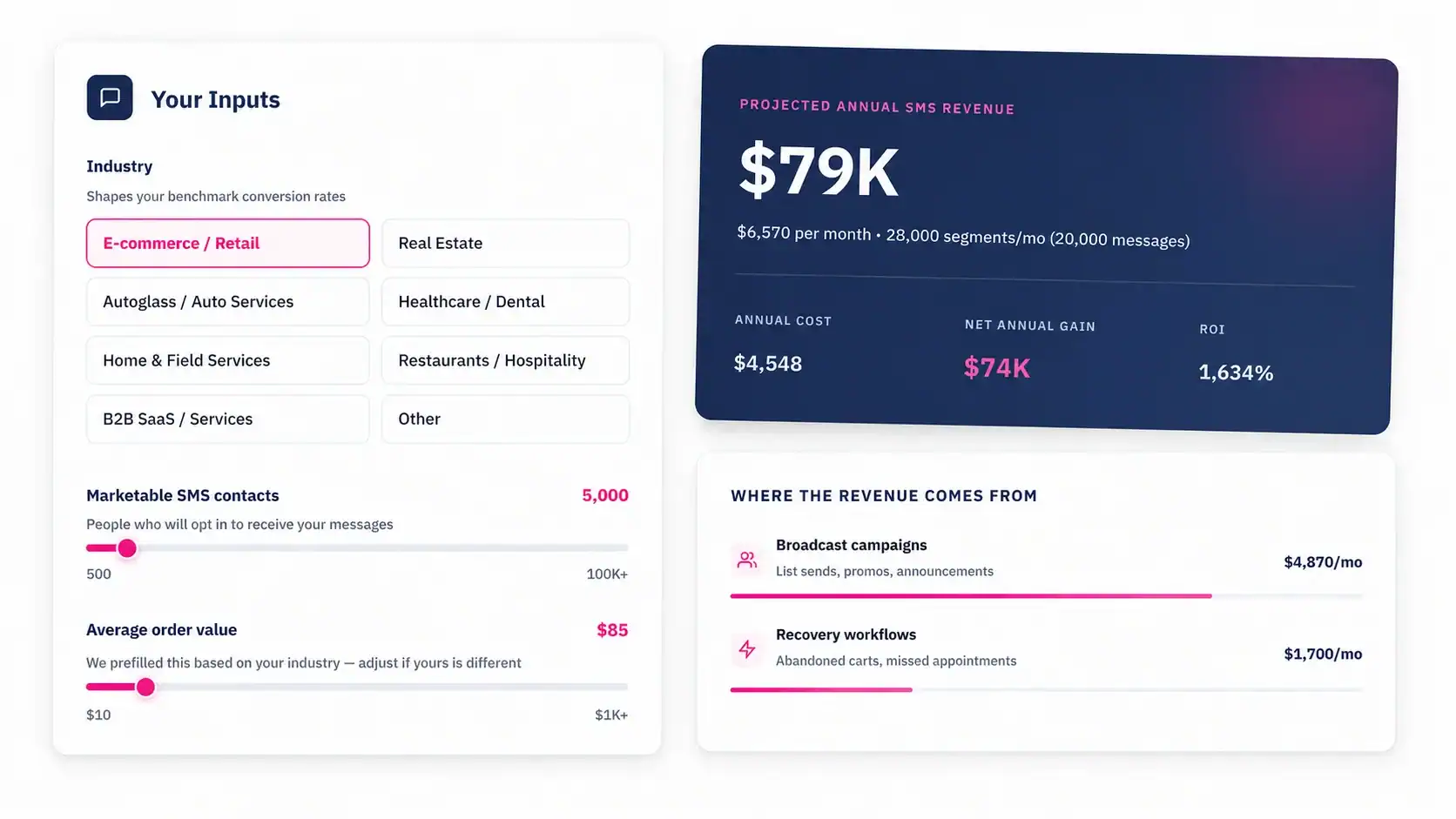
Talk to an Expert