

A text gets read within minutes. An email asking for a review usually sits in an inbox until it’s deleted, unread, days later. That gap is why SMS review requests convert at a meaningfully higher rate than email for most service businesses, and why more companies are moving review generation into text.
Done badly, it’s also the fastest way to get marked as spam or to trigger a review-platform violation. This is the practical version: when to send, what to say, what the rules actually require, and what to measure.
Why text works better than email for this specific ask
- A review request is a small, single-action ask (“tap this link, tap a star”). SMS is built for small, single-action asks; email is built for longer content the reader processes later.
- Review requests have a short shelf life. The customer’s memory of the experience fades daily. A channel with near-immediate read times matters more here than for a newsletter.
- Text feels personal and immediate in a way a templated email doesn’t, which is part of why reply and completion rates run higher, even though exact numbers vary widely by industry and list quality.
The compliance line you can’t cross: review gating

Before templates and timing, this matters more: in the United States, the FTC’s rule on fake and deceptive reviews (effective 2024) restricts “review gating”, the practice of asking customers how they feel first and only routing happy customers to a public review site while quietly diverting unhappy ones to a private form.
- What’s restricted: filtering who gets asked to leave a public review based on their predicted sentiment.
- What’s generally fine: asking every customer the same question and offering a way to reach support directly, without hiding negative outcomes from the public review flow.
- The safer pattern: send the same review-site link to everyone. Offer a separate, clearly-labeled “talk to us directly” option that any customer can choose, but don’t make public review visibility conditional on a sentiment score.
This isn’t legal advice and rules vary by platform and region. If review generation is a meaningful part of your growth plan, it’s worth a few minutes with counsel or your platform’s own review guidelines (Google, Yelp, and industry-specific sites each publish their own policies on top of the FTC rule).
When to send: timing by trigger event
The single biggest lever in review request performance isn’t the message copy, it’s timing relative to the experience. Send too early and the customer hasn’t formed an opinion yet. Send too late and they have forgotten the specifics.
| Trigger event | When to send | Why this timing |
| Job or service completed | 1-4 hours after | Experience is fresh; too soon feels transactional, too late loses recall. |
| Order delivered | 1-2 days after delivery | Gives the customer time to actually use the product before rating it. |
| Appointment or visit finished | Same day, evening | Still fresh, avoids interrupting the customer during their day. |
| Support ticket resolved | Within 1 hour of resolution | The resolution, not the original problem, is what’s being rated. |
| Subscription renewal or repeat purchase | After 2nd or 3rd purchase, not the 1st | One purchase isn’t enough signal that the customer is a genuine advocate. |
What to say: templates by industry
Every effective review request template does three things: references the specific experience (not generic), makes the ask a single tap, and keeps the message under 2-3 sentences. A few examples:
- Home services (HVAC, plumbing, roofing): “Hi Jordan, thanks for having us out today! If you have 30 seconds, a quick review helps other homeowners find us: [link]”
- Healthcare and dental: “Thanks for visiting Dr. Patel’s office today. We’d appreciate a quick review if you have a moment: [link]. Reply STOP to opt out.”
- Real estate: “Congrats again on closing! If you were happy with how things went, a short review means a lot to us and helps future buyers: [link]”
- Restaurants: “Thanks for dining with us tonight! Mind leaving a quick review? Takes 30 seconds: [link]”
- Auto glass and local retail: “Your windshield repair is done, drive safe! If we earned it, a quick review helps other local drivers find us: [link]”
Notice none of these ask “were you satisfied?” before sending the link. That question is the review-gating pattern to avoid.
Cadence: how often to ask, and when to stop
- One request per completed interaction, not per day. A customer who had three appointments this month gets one well-timed request, not three.
- One follow-up, maximum, after 3-4 days of no response. A second nudge is normal. A third starts to read as pressure and increases opt-outs.
- Respect STOP immediately and permanently for that contact. This is both a compliance requirement and a trust issue: a customer who opts out of one campaign type shouldn’t have to opt out of every campaign type separately unless your consent records are genuinely segmented that way.
- Space repeat customers by their actual purchase cycle, not a fixed calendar cadence. A quarterly service customer doesn’t need a review request every 30 days.
Get Your Ultimate HubSpot Text Messaging Playbook for FREE
Discover how top HubSpot teams use SMS to boost engagement, close deals faster and streamline operations.
Instant download
Expert insights from certified HubSpot professionals
Ultimate Text Messaging Playbook
What to measure (and what to ignore)
- Response rate: percentage of review requests that get any reply or click, the clearest signal of whether timing and copy are working.
- Completion rate: percentage of clicks that turn into an actual posted review. A gap between response and completion usually points to friction on the review platform’s side, not the text.
- Review volume trend, month over month, segmented by which trigger event generated the request.
- Average rating trend. If average rating is a concern, that’s a service quality question the review data is surfacing, not something to solve by suppressing requests to certain customers.
- What to ignore: total messages sent as a standalone metric. Sending more requests to the same finite customer base doesn’t scale results and increases opt-out risk.
Common mistakes
- Asking before the experience is complete. A mid-service or mid-order review request reads as premature and often gets a lower, less-informed rating.
- Using a generic template with no specific reference to the interaction. “Thanks for your business!” converts worse than a message referencing the actual service or product.
- Review gating, even unintentionally. A support workflow that quietly routes only 5-star-predicted customers to the public review link is the exact pattern regulators are targeting.
- Sending outside reasonable hours or without an easy opt-out, which is both a compliance issue and a fast way to generate spam complaints.
- Treating every customer segment the same. A one-time transactional buyer and a long-term repeat client warrant different timing and different message tone.
How this plays out across industries
- Home and field services: review requests triggered the moment a job status flips to “completed” in the CRM tend to outperform a manually-sent batch at end of week, since the trigger fires while the work is still visibly fresh.
- Healthcare and dental: timing right after a visit works well, but message copy needs extra care around consent language and shouldn’t reference specific treatment details in the text itself.
- Real estate: the highest-converting moment is right after closing, tied to a genuinely emotional milestone, not a generic quarterly check-in.
- Restaurants and hospitality: same-night requests after a reservation or delivery outperform next-day sends, since dining experiences fade from memory quickly.
- Ecommerce and retail: timing after delivery, not after purchase, matters most, since the product experience is what’s actually being reviewed.
FAQ
Is it legal to ask for reviews by text message?
Generally yes, provided you have the right consent to text that contact in the first place and you don’t filter who receives the request based on predicted sentiment. Consent and opt-out rules that apply to any business SMS also apply here.
Do I need separate consent specifically for review requests?
This depends on how your original opt-in was worded and on the platform sending the messages. Some businesses treat review requests as transactional (tied to a completed service) rather than marketing, which can carry different consent requirements. Confirm the classification with whoever manages your SMS compliance setup.
How soon after the experience should I send the request?
As a general rule, within hours to 1-2 days depending on the interaction type. Service completions and appointments skew toward same-day; delivered physical products skew toward a day or two after delivery so the customer has actually used the item.
Can I automate this from my CRM instead of sending requests manually?
Yes, and it’s generally more effective. Triggering the text from a status change (job completed, ticket closed, deal closed-won) removes the lag between the experience and the ask, which is the single biggest factor in response rate.
What if a customer replies with a complaint instead of a review?
Route it to a real person immediately. A text reply to a review request is a live, engaged customer; treat the complaint as a service recovery opportunity, not a data point to suppress.
Will asking too often hurt my SMS deliverability?
Excessive requests increase opt-out and spam-complaint rates, which carriers do track and which can affect deliverability for your number over time. One request per completed interaction, one follow-up maximum, keeps this risk low.
See how much revenue SMS could add to your HubSpot stack
Five inputs. Industry-backed benchmarks. Get your projected annual SMS revenue in under 30 seconds.
Calculate My SMS ROI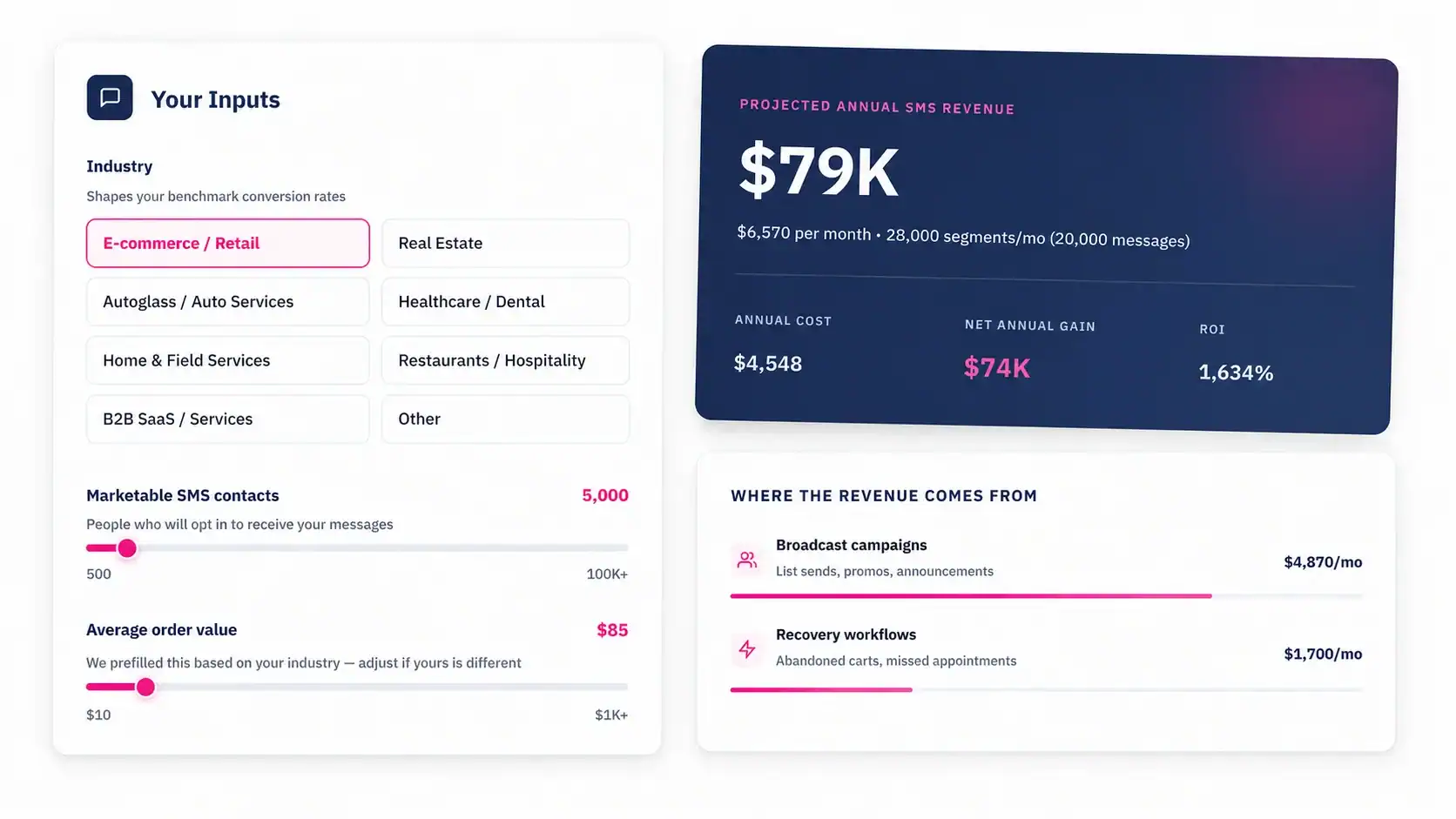
Where this leaves you
The mechanics matter more than the platform: the right trigger, the right timing, and a message that references the actual experience. If your review requests are still going out as a manual batch process, the biggest single improvement is triggering them automatically off a real status change in your CRM, whether that’s a job completion, a closed deal, or a resolved ticket. Message IQ can fire that text the moment the status updates in HubSpot, so the request goes out while the experience is still fresh instead of whenever someone remembers to send a batch.