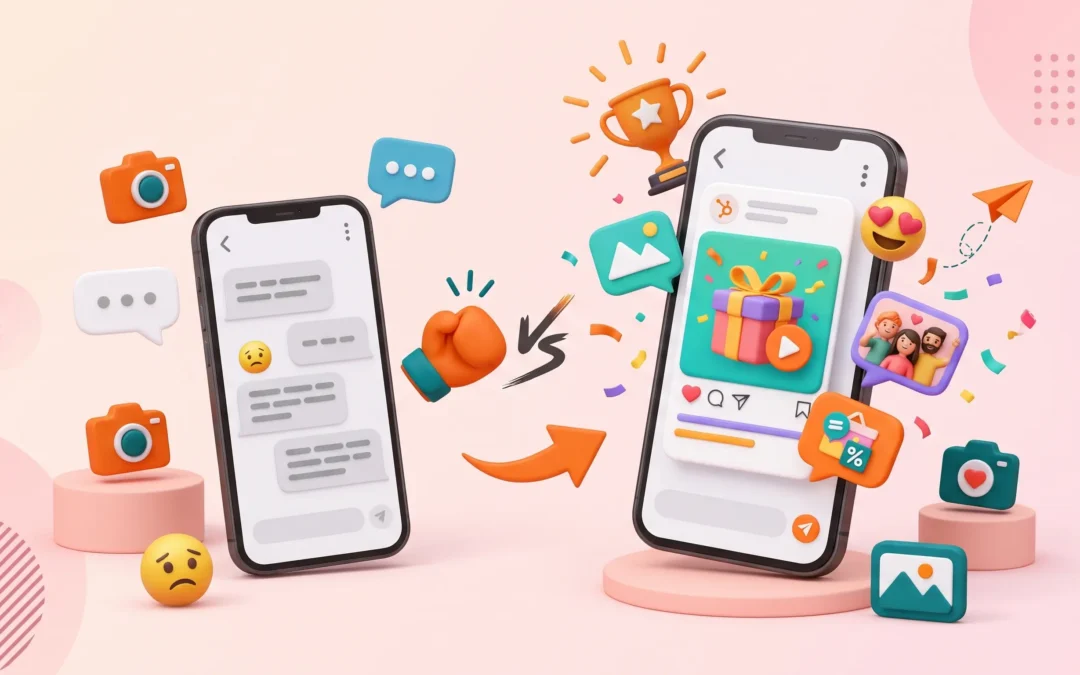
MMS marketing looks like an easy upgrade. You add a photo, the message looks better, and clicks should follow. Then the bill shows up, and each picture message costs about two and a half times what a plain text costs. So the useful question is when the image earns its price.
MMS marketing is the use of Multimedia Messaging Service to send promotional or service texts that carry an image, GIF, short video, audio clip, or PDF along with the written message. MMS moves over the carrier’s data network, so it handles larger files and much longer copy than plain SMS. In the US and Canada, businesses send MMS from the same 10DLC, toll-free, and short code numbers they use for SMS.
This guide covers how MMS differs from SMS, what each one really costs, the campaigns where pictures pay off, and the delivery problems that tend to show up after the first big send.
How MMS differs from plain SMS
SMS carries text and links only, and it splits anything long into billable segments. MMS carries media plus long text in one message, costs more per send, and depends on the recipient’s phone having mobile data.
| SMS | MMS | |
|---|---|---|
| What it carries | Text and links | Text plus image, GIF, video, audio, or PDF |
| Length per unit | 160 characters, or 70 if the text has any emoji | One message, with long text allowed |
| How it’s billed | Per segment | Per message |
| Twilio US list price (outbound) | $0.0083 per segment | $0.022 per message |
| AT&T pass-through fee (from April 1, 2026) | $0.0035 | $0.0090 |
| File size to aim for | Not applicable | 500 KB or less |
| Needs mobile data on the phone | No | Yes |
Prices: Twilio US SMS/MMS pricing and Vonage’s carrier fee notice. Your provider’s rates will differ.
The segment rule is where SMS costs creep up. Twilio’s character limit guide explains that a plain-text SMS fits 160 characters, but one emoji or curly quote switches the whole message to Unicode and drops the limit to 70. Longer messages split into 153-character segments (67 with Unicode), and the carrier charges for every one. A 300-character promo is two SMS charges. Add a single emoji and it becomes five.
What does MMS marketing cost compared to SMS?
A single MMS costs about 2.6 times a single-segment SMS at list rates. Long texts flip that math, though, because an MMS is one charge no matter how much text it carries.
Here’s a worked example using Twilio’s list price plus AT&T’s April 2026 pass-through fee:
- One-segment SMS: $0.0083 + $0.0035 = $0.0118
- One MMS: $0.022 + $0.009 = $0.031
- Three-segment SMS (307 to 459 plain characters): 3 × $0.0118 = $0.0354
So at these rates, any plain-text message over 306 characters costs more as SMS than as one MMS. With an emoji in the copy, the crossover drops to 135 characters.
On a 10,000-contact send of a short message, though, SMS costs about $118 and MMS about $310. That $192 gap repeats every time you send. Carrier fees also vary: Vibes’ published fee table lists T-Mobile at $0.01 per MMS, and Verizon moved to $0.0070 per MMS in May 2026. Many SMS platforms also count one MMS as several message credits, so check your own plan before you budget.
When does MMS marketing beat plain SMS?
MMS wins in three situations: the picture carries information words can’t, the message would run past two or three SMS segments anyway, or the reader needs to recognize your brand at a glance. Outside those cases, the image mostly adds cost.
The benchmark data backs that up. Klaviyo’s campaign benchmarks, built from US customers’ SMS data, report that SMS and MMS campaigns perform almost the same overall. MMS showed slightly higher revenue per recipient and a slightly lower unsubscribe rate. You’ll also see a claim that MMS gets “52% higher click-through rates” repeated across vendor blogs. We couldn’t trace it to a published study, so treat it as a guess until your own test confirms it.
These are the campaigns where a picture tends to earn its cost.
Product launches and visual offers
A photo of a new product, a menu item, or a before-and-after job does something 160 characters can’t. Retail, restaurant, and home services offers are the clearest fit, because the product is the pitch.
Event and webinar invites
A branded graphic with the date, time, and speaker gives people something to screenshot and save. In HubSpot, you can trigger the invite when a contact joins an event’s Active List, then send a plain SMS reminder the day before.
Long messages that would split anyway
Onboarding checklists, policy updates, and multi-step instructions often run 300 characters or more. One MMS arrives as a single bubble instead of fragments, and at the rates above it costs less.
Real estate and property inquiries
When a buyer fills out a listing form, a photo of that property in the first text reminds them which home they asked about. That helps when the buyer has asked about several homes in the same week.
Coupons and QR codes
A scannable code works at the counter without the customer opening a browser. Put the code value in the text body too, in case the image doesn’t load.
When is plain SMS the better choice?
Plain SMS is the better pick when speed, reach, or a personal tone matters more than looks. In these cases an image adds cost and a dependency on mobile data without adding much value.
- Appointment reminders and confirmations. The reader needs a time and a place. A graphic doesn’t make 2:30 PM any clearer.
- Two-way sales follow-ups. A rep’s short text reads like a person. A branded graphic reads like a broadcast, which is the wrong signal when you want a reply.
- Time-critical alerts and one-time codes. MMS needs data, so a phone on weak signal may not download the image right away.
- Big, low-margin broadcasts. At 50,000 contacts, the short-message gap from the example above grows to about $960 per send.
- B2B outreach. Busy buyers scan texts between meetings. Our SMS for B2B guide covers why short, specific texts tend to work better there.
Get Your Ultimate HubSpot Text Messaging Playbook for FREE
Discover how top HubSpot teams use SMS to boost engagement, close deals faster and streamline operations.
Instant download
Expert insights from certified HubSpot professionals
Ultimate Text Messaging Playbook
How do you send MMS marketing campaigns from HubSpot?
You send MMS from HubSpot through an SMS integration that adds a text action to your workflows and contact records. The flow mirrors an email campaign, with two extra steps for the image.
- Prepare the image. Upload it to HubSpot’s Files tool, keep it at 500 KB or less, and set it to public so the carrier can fetch it.
- Pick the audience. Use an Active List, a form submission, or a lifecycle stage change as the workflow trigger.
- Build the send. In Automation → Workflows, add your SMS app’s send action, write the text, attach the image, and add personalization tokens like first name.
- Shorten and track the link. A tracked short link saves characters and tells you who clicked.
- Test on real phones. Send to at least one iPhone and one Android on different carriers before the full send.
- Watch the contact record. Check delivery, clicks, and replies, then adjust the next send.
We built Message IQ to make this flow feel like sending a HubSpot email. The Message IQ workflow action lets you add personalized text and picture messages inside any workflow, and every delivery, click, and reply lands on the contact record. Our HubSpot SMS send guide walks through the setup screen by screen. For copy ideas, our text message templates work for both SMS and MMS.
What goes wrong with MMS campaigns?
The common MMS problems come from file size, image format, registration, and consent. You can prevent each one before you send.
Files that are too big
Carriers cap MMS size, and the caps differ. Bandwidth’s MMS size guide lists 10DLC limits of 1 MB at AT&T, 1.2 MB at Verizon, and 3 MB at T-Mobile, but still advises keeping the full payload under 500 KB. Some providers resize oversized images. Others just fail the send. Export at 640 pixels wide as a compressed JPG and you’ll rarely hit a limit.
Transparent PNGs
Phones handle transparency differently. A logo on a transparent background can show up on black, white, or the message bubble color. Flatten the image onto a solid background before you upload it.
Unregistered numbers
MMS from a 10-digit long code needs the same 10DLC brand and campaign registration as SMS, as Vonage’s MMS documentation notes. Carriers block unregistered traffic, and an MMS block wastes more money per message. Our SMS deliverability guide covers registration and the other carrier checks.
Putting the whole offer inside the image
If the image fails to load, the reader sees nothing useful. Screen readers can’t read text inside an image either. Keep the offer, the link, and the opt-out line (“Reply STOP to opt out”) in the text body.
Treating MMS as a consent loophole
MMS falls under the same rules as SMS. You still need express written consent for marketing texts under the TCPA, and you still have to honor STOP, UNSUBSCRIBE, QUIT, and CANCEL. Our TCPA and CAN-SPAM guide explains what counts as valid consent.
When a send does fail, the error you get depends on your provider. A provider with direct carrier relationships can usually tell you which carrier rejected the message and why, instead of returning a generic “undelivered” status.
How to decide whether MMS fits your program
Run one controlled test before you switch any campaign to MMS. Judge the result on cost per conversion, and treat click rate as a supporting number.
- Pick one campaign where the image carries information, such as a product launch or event invite.
- Split the audience. In HubSpot, create two random halves of the same list and send identical text, one with the image and one without.
- Measure four numbers: click rate, conversion rate, unsubscribe rate, and total send cost.
- Divide cost by conversions. If MMS costs 2.6 times as much, it needs about 2.6 times the conversions to break even.
- Roll out only where MMS wins, and keep plain SMS everywhere else.
If you’re already running your marketing in HubSpot, see how SMS for HubSpot handles text and picture messages inside the workflows you already use.
FAQ
What is the difference between SMS and MMS marketing?
SMS marketing sends text-only messages of up to 160 characters per segment. MMS marketing adds an image, GIF, video, audio clip, or PDF and allows much longer text in a single message. MMS costs more per send and needs mobile data on the recipient’s phone.
How much does MMS cost compared to SMS?
At Twilio’s US list rates plus AT&T’s April 2026 carrier fee, one MMS costs about $0.031 and a one-segment SMS costs about $0.0118, so MMS runs about 2.6 times higher. For plain-text messages longer than 306 characters, one MMS can cost less than the three or more SMS segments it replaces. Message IQ plans start at $29 a month, month-to-month.
What file size should MMS images be?
Keep the full MMS payload at 500 KB or less for reliable delivery across US and Canadian carriers. Some carriers accept 1 MB or more, but limits differ by carrier and number type. A compressed JPG about 640 pixels wide usually fits well under the limit.
Do MMS messages need separate consent from SMS?
You don’t need a separate consent form, but MMS follows the same rules as SMS. You need express written consent for marketing messages under the TCPA, a registered 10DLC brand and campaign for long-code sending, and support for opt-out keywords like STOP.
Can you send MMS from HubSpot workflows?
Yes, through an SMS integration from the HubSpot App Marketplace that adds a send action to workflows. You upload the image to HubSpot Files, attach it in the workflow action, and personalize the text with HubSpot tokens. Delivery, clicks, and replies then log to the contact record.
Does MMS always get higher click rates than SMS?
No. Klaviyo’s US benchmark data shows SMS and MMS campaigns performing almost the same overall, with MMS slightly ahead on revenue per recipient and slightly lower on unsubscribes. MMS tends to win when the image carries real information, so test it against SMS on your own list.
See how much revenue SMS could add to your HubSpot stack
Five inputs. Industry-backed benchmarks. Get your projected annual SMS revenue in under 30 seconds.
Calculate My SMS ROI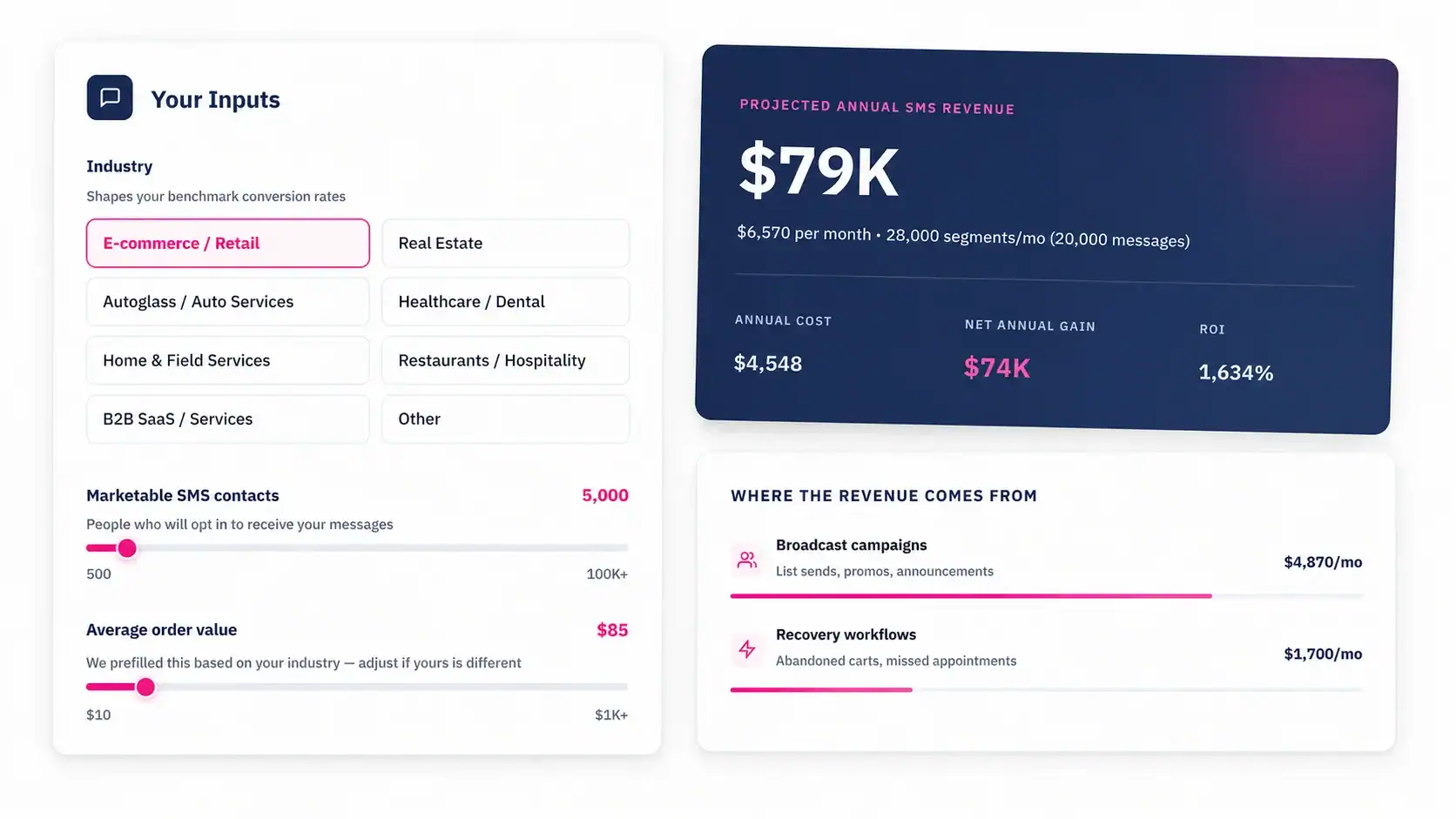
See how picture messages fit your HubSpot setup
You don’t need to move your whole SMS program to MMS. A few visual campaigns on top of plain-text reminders and conversations is a sensible place to start.
If you want to try both from inside HubSpot, Message IQ plans start at $29 a month, month-to-month, with a 30-day money-back guarantee. It works for contacts in the US and Canada. You can compare plans on our pricing page or install Message IQ from the HubSpot Marketplace.