
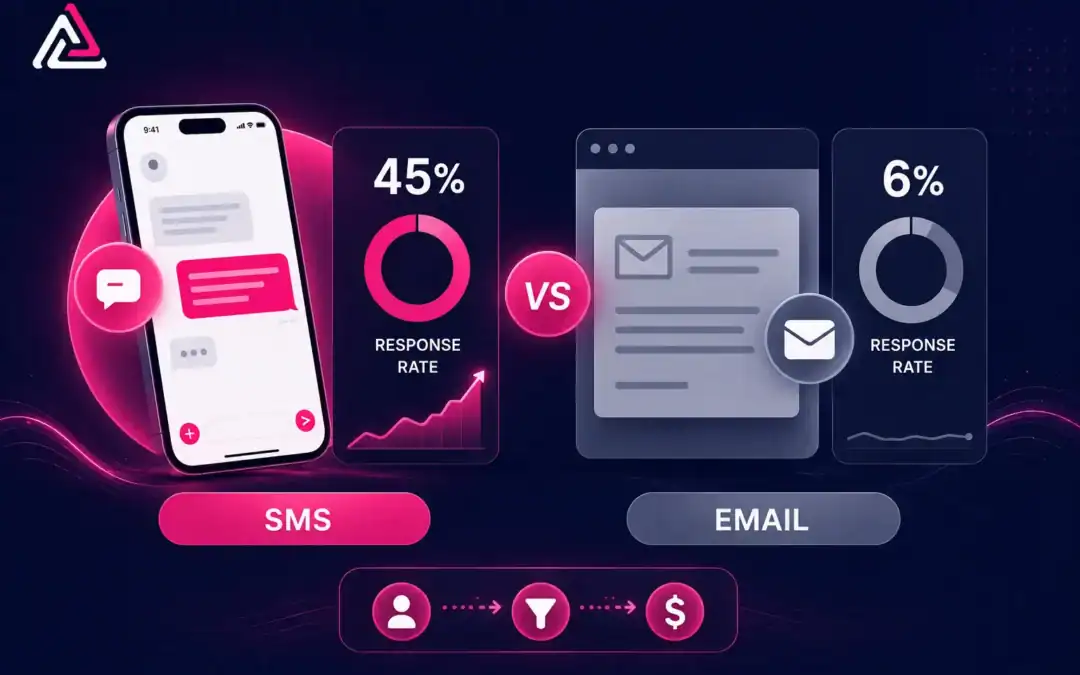
Your B2B pipeline has a response problem. Sales reps send five emails, get silence, and assume the prospect is gone. Meanwhile, a single text message to the same contact would have hit a 45% response rate versus the 6% they’re getting from email. The gap between sms vs email response rates b2b is not a minor edge case – it’s a structural advantage most revenue teams are leaving on the table entirely.
At MessageIQ, we’re built by HubSpot Diamond Solutions Partners specifically to bring two-way SMS inside HubSpot workflows. We see this gap play out every week: the same contacts that go cold in an email sequence come back to life the moment a rep sends a short, personalized text.
This article breaks down exactly what the data says, why that 39-point response rate gap exists, and how to build it directly into your HubSpot pipeline so you stop losing deals to inbox noise.
What Are SMS vs Email Response Rates in B2B?
SMS vs email response rates B2B measures how often business recipients reply to a text message versus an email. Across 2026 benchmarks, SMS averages a 45% response rate compared to 6% for email. This means for every 100 outreach messages sent, SMS generates roughly seven times more replies than email. For B2B sales and marketing teams that depend on two-way conversations to qualify leads and progress deals, that ratio matters at every stage of the pipeline.
The 45% vs 6% Gap: What the Data Actually Shows
The headline stat is already out there. But the individual numbers around it tell the more interesting story for B2B teams.
Open rate: SMS hits 90 to 98%, while email sits at 20 to 28% for B2B campaigns. That means roughly three out of four emails never get read, before you even get to the response question.
Time to read: 95% of text messages are read within 3 minutes of delivery. The average email takes over 4 hours to be opened.
Response time: SMS responses arrive within 90 seconds on average. Email responses average 90 minutes, with cold B2B email often taking 24 to 48 hours or longer.
Click-through rate: SMS with a link generates CTR between 18% and 36%. Email sits between 1.5% and 5% in B2B campaigns.
Conversion rate: Well-optimized SMS campaigns report conversion rates between 21% and 30%. Email typically converts at 2% to 5% for cold outreach.
When you look at the full funnel, email losses compound. Low open rate creates a drop-off before the message is read. Low CTR means fewer people act. Low response rate means fewer conversations start. SMS narrows each gap simultaneously because it bypasses the inbox entirely and lands where people actually look: their phone’s native messaging app.
For B2B specifically, B2B SMS callbacks convert 6% into qualified calls, dramatically higher than cold email reply-to-call conversion, and SMS win-back campaigns convert at 7%, event reminder SMS boosts attendance by 24%, and subscription renewal SMS increases renewals by 18% – results that show up specifically at the conversion points that define B2B revenue operations.
Why SMS vs Email Response Rates B2B Diverge So Sharply
The gap between sms vs email response rates b2b isn’t random. It’s structural. Email became the default channel for B2B communication, which created saturation. The average B2B decision-maker receives 121 emails every single day. Add aggressive spam filtering, promotion tabs, and inbox zero anxiety, and even a great email can disappear before it’s seen.
SMS doesn’t face any of those barriers. There’s no spam folder. No algorithm deciding whether your message qualifies for the primary inbox. No image rendering delay or unsubscribe footer that signals “marketing.” A text lands as a notification on a device that’s within arm’s reach of most people for most of the day.
There’s also a psychological dimension. Email has conditioned business recipients to defer. People sort by sender, scan subject lines, and batch-process follow-up. Texts create a low-friction, conversational environment where a quick reply feels natural. That’s why response rates don’t just improve slightly, they multiply.
The combination of high open rate, high response rate, and the immediacy of the medium creates a follow-up touchpoint that interrupts the prospect’s day in a way that feels more human than a fifth email in a sequence.
SMS vs Email Response Rates B2B: Side-by-Side Comparison
Use this table when building the business case internally or presenting to leadership.
| Metric | SMS (B2B) | Email (B2B) |
| Open Rate | 90 to 98% | 20 to 28% |
| Response Rate | 45% | 6% |
| Time to Read | Under 3 minutes | 4+ hours |
| Click-Through Rate | 18% to 36% | 1.5% to 5% |
| Conversion Rate | 21% to 30% | 2% to 5% |
| Average Response Time | ~90 seconds | ~90 minutes |
| Spam Risk | Very low | High (filters, tabs) |
| Best Use Case | Speed-to-lead, follow-up, reminders | Long-form content, formal comms |
| HubSpot Native Trigger? | Yes (via MessageIQ) | Yes |
The table above doesn’t argue for replacing email. It shows where each channel belongs. Email handles the depth – white papers, case studies, proposals, formal contracts. SMS handles the speed and the conversation – the moments where a reply in 90 seconds is worth more than a well-designed email that gets opened three days later.
For a deeper look at how these two channels split in practice, see our dedicated breakdown of SMS vs email for HubSpot teams.
Where the B2B Response Rate Gap Hits Your Pipeline Hardest
Not every stage of a B2B pipeline suffers equally from low email response rates. These four scenarios are where sms vs email response rates b2b diverge most sharply and cost the most revenue.
Speed-to-Lead
The first five minutes after a lead fills out a form are critical. Research consistently shows that contact rates drop significantly after that window closes. Email follow-up, even automated, often hits the inbox while the lead is still on your site – but goes unread for hours. An SMS sent within 90 seconds of form submission creates a real-time response window that email simply can’t match.
Post-Demo Follow-Up
Deals stall after demos more often than at any other stage. Email follow-ups get written, polished, and sent – and then die in an inbox. A short SMS sent within 2 hours of the demo call asking a single, specific question (“Any questions before I send the proposal, {{first_name}}?”) generates replies at a rate that keeps deals moving.
Dormant Pipeline Reactivation
Cold pipeline is where the email response gap is most brutal. Contacts who haven’t replied to three or four emails are, from the inbox’s perspective, just more noise. A brief, personal SMS re-engagement – referencing something specific from the earlier conversation – breaks the pattern. Automated text sequences generate up to 30x more revenue per recipient than one-time campaigns because they are precisely timed and targeted.
Meeting and Demo Reminders
No-shows kill pipeline velocity. Email reminders get buried. SMS reminders get read. Sending a confirmation text 24 hours before a meeting and a brief reminder 1 hour before consistently reduces no-show rates in B2B contexts.
How to Build SMS vs Email Response Rates B2B Thinking into Your HubSpot Workflows
Understanding the gap is one thing. Building it into your actual HubSpot workflows is what creates compounding pipeline improvement.
MessageIQ connects directly to HubSpot as a native workflow action – no Zapier, no middleware, no third-party trigger. Every SMS fires from inside a HubSpot workflow using contact properties, deal stage data, and enrollment triggers you already have configured. All conversations land in a shared team inbox so any rep can see the thread, reply, and hand off without losing context.
Here’s how to build four of the highest-impact workflows.
Workflow 1: Speed-to-Lead SMS
- Enrollment trigger: Contact submits a demo request or contact form
- Action: MessageIQ sends SMS within 90 seconds via HubSpot workflow action
- Delay: Wait 10 minutes
- Branch logic: If contact replied to SMS, assign to sales rep and create deal | If no reply, send automated follow-up email and queue for SMS follow-up after 4 hours
Workflow 2: Post-Demo Pulse Check
- Enrollment trigger: Deal stage moves to “Demo Completed”
- Delay: Wait 2 hours
- Action: MessageIQ sends personalized SMS to the primary contact
- Branch logic: If contact replies positively, notify rep immediately | If no reply after 24 hours, enroll in email follow-up sequence
Workflow 3: Dormant Deal Reactivation
- Enrollment trigger: Deal has been in current stage for 21+ days with no activity logged
- Action: MessageIQ sends re-engagement SMS referencing the last interaction
- Delay: Wait 3 days
- Branch logic: If contact replies, create task for rep to call within 1 hour | If no reply, send a final reactivation email
Workflow 4: Meeting Reminder Sequence
- Enrollment trigger: Meeting booked and confirmed in HubSpot calendar
- Action: MessageIQ sends confirmation SMS immediately after booking
- Delay: Wait until 24 hours before meeting
- Action: Send reminder SMS with meeting link
- Delay: Wait until 60 minutes before meeting
- Action: Send final reminder SMS: “Your call starts in 1 hour – here’s the link: {{meeting_link}}”
For a complete setup guide, see how to integrate HubSpot SMS with MessageIQ.
Get Your Ultimate HubSpot Text Messaging Playbook for FREE
Discover how top HubSpot teams use SMS to boost engagement, close deals faster and streamline operations.
Instant download
Expert insights from certified HubSpot professionals
Ultimate Text Messaging Playbook
Copy-Paste SMS Templates for B2B Response Rate Improvement
The fastest way to close the sms vs email response rates b2b gap is putting the right message in front of the right contact at the right moment. These templates are sized for maximum deliverability and built for the B2B contexts where response rates are highest.
Use case: Speed-to-lead follow-up (post form submission)
“Hi {{first_name}}, thanks for reaching out to MessageIQ. I’d love to show you how we fit inside your HubSpot in about 15 minutes – do any of these slots work? {{calendar_link}} – {{rep_name}}” (163 chars)
Use case: Post-demo follow-up
“{{first_name}}, great talking through your HubSpot setup today. One question before I send the proposal: what’s your biggest friction point right now between form fill and first contact? – {{rep_name}}” (199 chars)
Use case: Dormant pipeline reactivation
“Hi {{first_name}}, {{rep_name}} here from MessageIQ. We spoke about SMS for your HubSpot workflows back in {{last_contact_month}}. Things may have changed – worth a 10-min catch-up? Reply YES or NO.” (198 chars)
Use case: No-show meeting reminder
“{{first_name}}, your call with {{rep_name}} starts in 1 hour. Join here: {{meeting_link}} – reply if you need to reschedule.” (124 chars)
For a full template library across sales, support, and marketing use cases, browse MessageIQ’s SMS template collection.
TCPA and 10DLC Compliance for B2B SMS Outreach
The sms vs email response rates b2b advantage only holds if your messages actually reach the contact. And in 2026, carrier filtering is aggressive enough that non-compliant SMS programs get filtered before delivery.
Written consent is non-negotiable. B2B contexts don’t get a compliance bypass. Before sending SMS to any contact, you need explicit written consent to receive text messages from your company specifically. This means opt-in language on forms, confirmation messages, and logged consent records in your CRM.
10DLC registration protects deliverability. All A2P (application-to-person) SMS sent in the US must be registered under the 10DLC framework with your brand and each message campaign. Unregistered numbers see significantly higher filtering rates, which directly erodes your response rate advantage.
Opt-out must be instant and permanent. Any reply of “STOP,” “UNSUBSCRIBE,” or similar must immediately remove the contact from your send list. MessageIQ handles opt-out automatically and logs it to the HubSpot contact record, so no rep accidentally sends a follow-up to an opted-out contact.
Timing matters under TCPA. Messages sent outside 8 AM to 9 PM local time are a violation. MessageIQ’s send time controls let you set time zone-aware delivery windows so automation never fires outside compliant hours.
For a full compliance walkthrough, see our guide to TCPA consent language for SMS and the A2P 10DLC brand registration process.
When to Use SMS vs Email in Your B2B Pipeline
This isn’t an either/or decision. The highest-performing B2B outreach programs use both channels, assigning each one to the scenarios where it performs best. The most effective approach combines both – SMS following email can boost engagement 20 to 30%.
Here’s the practical split:
Use SMS when:
- A reply in under 5 minutes changes the outcome (speed-to-lead, meeting reminders)
- You need to break a pattern with a cold or dormant contact
- A single question is all that’s needed to move the deal forward
- Timing is the deciding factor (flash offer, limited seat event, approval deadline)
Use email when:
- The message contains attachments, proposals, or documents
- You’re distributing educational content for long-cycle nurture
- Multiple stakeholders need to be CC’d or forwarded
- You need a formal, archivable record of the communication
Use both when:
- Running a multi-touch outbound sequence (email day 1, SMS day 3, call day 5)
- Following up after a webinar or live event (email summary, SMS call-to-action)
- Onboarding a new customer (email the full guide, SMS a specific action prompt)
For a full breakdown of when to choose SMS over email for each scenario, we’ve mapped the decision across 12 common B2B contexts.
Why MessageIQ Closes the SMS vs Email Response Rates B2B Gap Faster
Most SMS tools bolt onto HubSpot through a Zap or an API webhook. That means your SMS trigger is only as reliable as the connection between two separate platforms, and your CRM data often lags behind what’s actually firing.
MessageIQ is built natively inside HubSpot by the team at IntegrateIQ, a HubSpot Diamond Solutions Partner. The difference shows up in a few specific ways:
- Native workflow action: No Zapier. SMS triggers fire directly inside HubSpot workflows using real-time contact and deal data
- Two-way by default: Every conversation is two-way, not a one-way blast. Replies flow into a shared team inbox that any rep can see and respond to from HubSpot
- Shared team inbox: Sales, support, and CS teams see every thread. No missed follow-ups because the original sender is out of office
- Any HubSpot tier: MessageIQ works with Starter, Professional, and Enterprise – you don’t need Marketing Hub Pro to get started
- TCPA-compliant opt-in/opt-out: Consent management is built in, not an add-on
Plans start at $99/mo, which puts two-way SMS automation inside HubSpot at a cost that’s accessible for growth-stage teams and solo operators alike.
FAQ: SMS vs Email Response Rates B2B
What is the average sms vs email response rate b2b? SMS averages a 45% response rate in B2B contexts, compared to 6% for email. That’s a 7x gap. For cold B2B email specifically, reply rates run between 1% and 5%, making the SMS advantage even more pronounced in outbound sequences.
Does SMS work for B2B sales outreach, or is it only B2C? SMS works strongly in B2B, particularly for speed-to-lead follow-up, meeting reminders, post-demo check-ins, and dormant pipeline reactivation. The key difference from B2C is message volume: B2B SMS is lower frequency, higher personalization, and tied directly to pipeline stages rather than promotional campaigns.
Do I need TCPA consent before texting B2B contacts? Yes. B2B does not exempt you from TCPA requirements. You need prior express written consent before sending any marketing or sales SMS to a business contact in the US. Consent can be collected via web form, verbal agreement with written confirmation, or CRM opt-in workflow.
How does sms vs email response rate b2b change for HubSpot users? HubSpot users who connect a native SMS tool like MessageIQ can trigger text messages from enrollment triggers, contact properties, and deal stage changes – the same logic that powers their email sequences. This lets SMS land at the exact moment it’s most likely to get a reply, which is within minutes of a key pipeline event rather than hours later.
What’s the right ratio of SMS to email in a B2B outreach sequence? A common starting point is one SMS for every four emails in a sequence. Adjust based on your audience’s preferences and your opt-in rate. For high-intent contacts like demo requests and trial signups, SMS can front-load the sequence because speed-to-contact matters most.
Does SMS cannibalize email performance in B2B? No. Adding SMS to an email sequence consistently improves total campaign performance. The combination of SMS with email in a coordinated sequence consistently generates significantly higher total campaign response rates than either channel produces independently. The channels work at different speeds and different modes of attention – they don’t compete for the same response window.
How do I track sms vs email response rates b2b inside HubSpot? MessageIQ logs every SMS send, delivery, reply, and opt-out directly to the HubSpot contact and deal record. You can report on reply rates by workflow, by lifecycle stage, or by rep inside HubSpot’s native reporting tools – the same way you’d report on email sequence performance.
See how much revenue SMS could add to your HubSpot stack
Five inputs. Industry-backed benchmarks. Get your projected annual SMS revenue in under 30 seconds.
Calculate My SMS ROI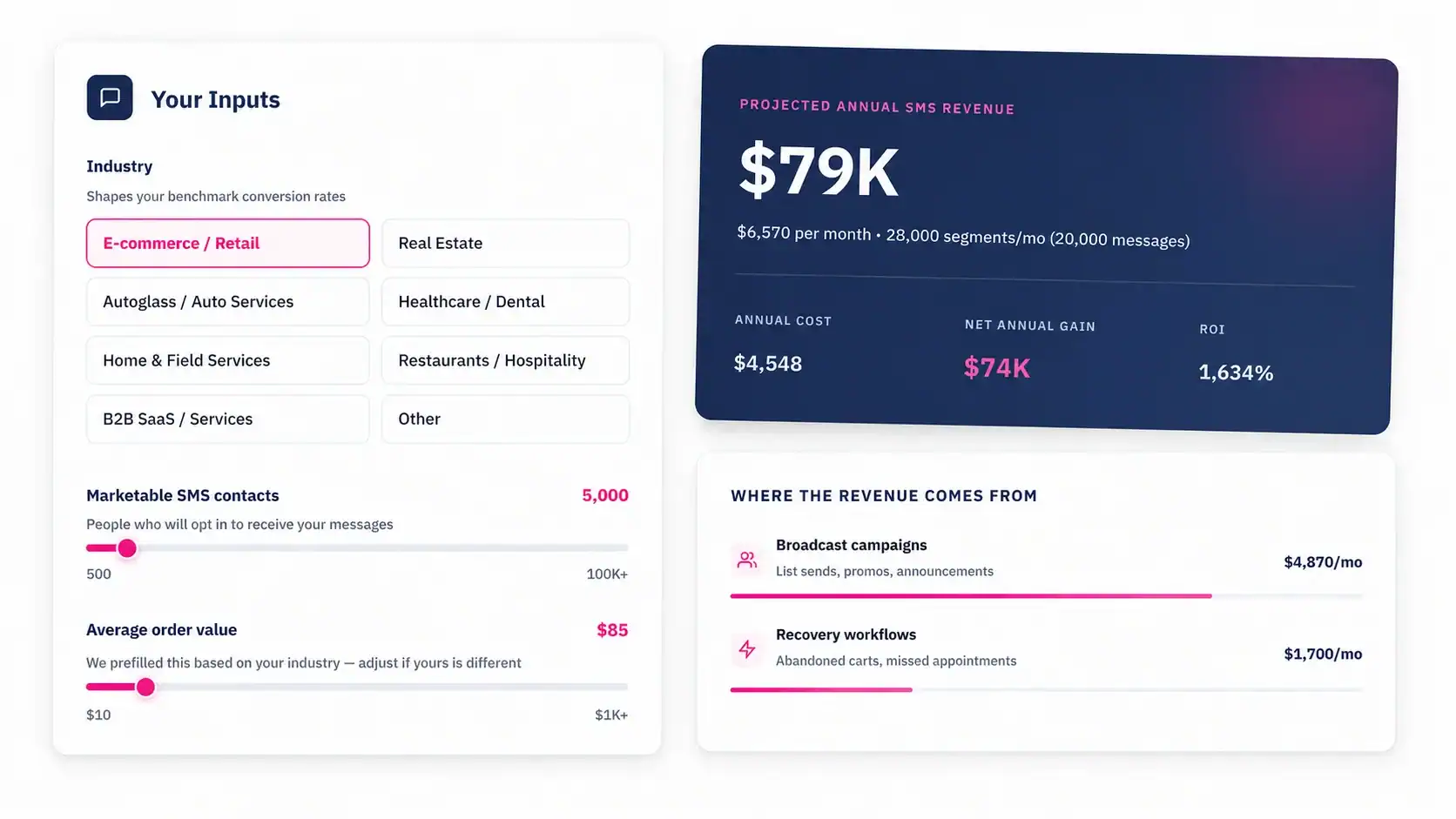
Start Closing the Gap
The data on sms vs email response rates b2b has been consistent for years: 45% vs 6%. Most B2B teams know the stat. Fewer have actually built SMS into their HubSpot pipeline in a way that compounds across every stage of the funnel.
If your pipeline is stalling after demo calls, losing speed-to-lead races, or watching cold contacts go permanently silent, adding two-way SMS to your HubSpot workflows is the highest-ROI change you can make to your outreach stack this quarter.
Try MessageIQ free and send your first automated SMS from HubSpot today. Plans from $99/mo. Setup takes under 10 minutes inside your existing HubSpot account.