

Most marketing teams treat SMS and email as either-or. That’s the wrong framing. The better question is: what does each channel actually cost, and where does each one produce the strongest return? The cost of SMS marketing vs email looks simple on the surface, but the numbers shift significantly once you factor in open rates, conversion velocity, compliance overhead, and how tightly each channel connects to your CRM.
At Message IQ, built by HubSpot Diamond Solutions Partners IntegrateIQ, we see both channels in action daily inside HubSpot workflows. Here’s how the economics actually stack up.
What Is the Cost of SMS Marketing vs Email?
The cost of SMS marketing vs email comes down to per-message pricing versus platform subscription costs, multiplied by engagement rates that differ by an enormous margin. SMS typically runs $0.01 to $0.05 per message in the US. Email costs roughly $0.001 to $0.005 per message on most platforms. But 98% of SMS messages are opened vs roughly 20% for email, which is why SMS follow-ups convert faster and often produce a lower cost per conversion despite the higher per-message rate.
SMS Marketing Costs: What You Actually Pay
Per-Message Pricing
US SMS marketing costs between $0.01 and $0.05 per message for standard SMS, and $0.02 to $0.08 for MMS (messages with images or rich media). International sends run higher, typically $0.05 to $0.15 depending on the destination country.
Most platforms charge through one of three models:
- Pay-as-you-go: No monthly commitment. You buy message credits as needed. Best for low-volume or seasonal campaigns.
- Monthly subscription: A flat fee that includes a set number of messages. Better for predictable, high-frequency programs.
- Volume tiers: Per-message rates decrease as your monthly volume increases. Standard for enterprise teams.
Volume Tiers: How Rates Drop as You Scale
Per-message SMS pricing is not flat. Most platforms drop your rate as monthly volume increases:
1- Small senders (1,000 to 10,000 messages/month): roughly $0.04 to $0.05 per message
2- Mid-size senders (10,000 to 100,000 messages/month): roughly $0.025 to $0.035 per message
3-Enterprise senders (100,000+ messages/month): roughly $0.015 per message and below, often with negotiated rates
If you’re budgeting off the top-line $0.01 to $0.05 range without knowing where your volume actually lands, you’re either overestimating a large campaign or underestimating a small one. Match your monthly send volume to the right tier before comparing it against email’s flat per-subscriber pricing.
Platform Fees
Beyond per-message costs, you’ll budget for the platform itself. Message IQ starts at $49/mo, which includes two-way SMS natively connected to HubSpot, a shared team inbox for sales and support, and TCPA-compliant opt-in/opt-out built in. Generic SMS platforms often charge more and still require a separate HubSpot integration layer.
Number Type Costs
The phone number your messages send from adds its own line item. Long code and toll-free numbers, the standard choice for two-way conversational SMS, run $2 to $25 per month. Short codes (the 5 to 6 digit numbers used for very high-throughput broadcast sending) cost $500 to $1,500 per month to lease and only make sense once your volume justifies it. MessageIQ runs on a long code or toll-free number by default, which keeps this cost in the single digits instead of four figures.
Compliance Costs
10DLC (10-Digit Long Code) registration is mandatory for US business SMS. Brand registration typically costs $4 to $20 one-time. Campaign registration runs $10 to $25 monthly per campaign. These are fixed, predictable costs, not variables that blow up your budget. You can read the full registration process in our guide to A2P 10DLC brand registration.
Email Marketing Costs: What You Actually Pay
Email’s cost advantage is real. Most platforms charge $0.001 to $0.005 per send, and for large lists the per-message economics look excellent on paper. A list of 50,000 contacts can cost $200 to $500 per month on platforms like Mailchimp or HubSpot Marketing Hub.
But the full cost picture includes:
- Platform subscription (scales with list size)
- Template design and copywriting
- List hygiene and validation tools
- Deliverability monitoring (especially as sender reputation becomes more tightly enforced)
The hidden cost nobody talks about is attention. Email open rates average 20 to 28% for B2B. That means 72 to 80% of the sends you paid for never get read. You’re not just paying per message, you’re paying for a channel where the majority of your messages disappear into an inbox nobody checks.
Cost of SMS Marketing vs Email: The ROI Numbers
Here’s the comparison that matters most to budget conversations.
| Metric | SMS Marketing | Email Marketing |
| Average open rate | 98% | 20-28% |
| Click-through rate | 19-36% | 0.77-4.36% |
| Response rate | 45% | ~10% |
| Average time to open | Under 3 minutes | 6+ hours |
| Cost per message (US) | $0.01 – $0.05 | $0.001 – $0.005 |
| Industry ROI benchmark | $21 – $71 per $1 spent | $10 – $42 per $1 spent |
| Abandoned cart recovery | 15-20% conversion | 5-10% conversion |
| Opt-out rate | Below 3% | Varies widely |
The ROI gap is wide. Industry benchmarks put SMS at $21 to $71 return per dollar spent versus $10 to $42 for email. The variation in SMS ROI comes from use case fit: time-sensitive campaigns (flash sales, cart recovery, appointment reminders) produce the highest returns. Nurture sequences and educational content, where email’s content flexibility shines, produce stronger email ROI.
Why This Comparison Needs a Caveat
The ROI multiples above aren’t directly comparable without context. SMS lists tend to be far smaller than email lists, and a smaller denominator inflates the ROI percentage. A more honest comparison is revenue per recipient: Omnisend’s 2026 data puts automated email flows at $2.87 per send versus $0.74 per send for automated SMS. Email still wins on total revenue for most teams because list size and cost per send both favor it at scale. SMS wins on ROI percentage and on speed, not on raw volume of revenue generated.
For teams using automated workflows, the numbers get more interesting. Automated SMS messages generate roughly $0.74 per send versus $0.15 for one-off campaign messages. Automation is where SMS inside HubSpot workflows earns its keep.
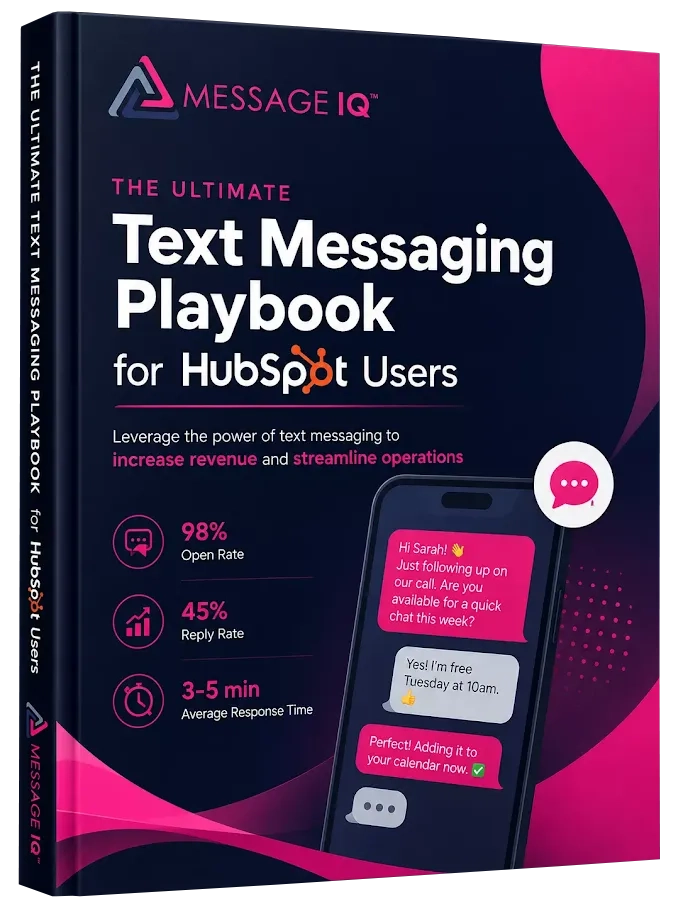
Get Your Ultimate HubSpot Text Messaging Playbook for FREE
Discover how top HubSpot teams use SMS to boost engagement, close deals faster and streamline operations.
Instant download
Expert insights from certified HubSpot professionals
Ultimate Text Messaging Playbook
Where SMS Wins on ROI
Speed-to-Lead
A lead fills out a demo form. If you follow up by phone within 5 minutes, your odds of qualifying that lead increase by 21x compared to a 30-minute follow-up. Email follow-ups average a 6+ hour open lag. SMS arrives in seconds and gets read within 3 minutes.
For B2B sales teams, this one use case alone often justifies SMS costs entirely. Our post on two-way SMS software for sales teams covers this in detail.
Appointment Reminders
No-shows cost service businesses real money. SMS appointment reminders consistently reduce no-show rates by 25 to 40%. Email reminders help, but the gap in open rates means SMS reminders reach more contacts in the time window that matters.
Abandoned Cart Recovery
Abandoned cart SMS converts at 15 to 20% vs 5 to 10% for email. For any team with an e-commerce or high-intent funnel component, that’s a significant revenue gap.
Flash Sales and Time-Sensitive Offers
An offer that expires in 4 hours loses most of its value if recipients read it the next day. Email’s open lag makes it a poor fit for urgency-driven campaigns. SMS delivers the message before the window closes.
Where Email Wins on ROI
Email’s ROI advantages are real in specific contexts. Don’t dismiss them.
Scale and Volume
You can email a list of 100,000 contacts for a fraction of what SMS costs. For brand awareness campaigns, newsletters, and content distribution, email’s cost-per-reach is difficult to beat.
Content Depth
SMS is constrained to 160 characters per segment (longer messages get billed in segments). Email handles images, video embeds, multi-section layouts, and long-form copy. Product launches, case studies, onboarding sequences, and anything requiring explanation perform better in email.
Frequency Tolerance
You can send email 8 to 12 times per month without burning your list. SMS best practice sits at 4 to 6 messages per month. High-frequency nurture programs are better served by email.
List Acquisition Costs
Growing an SMS list typically costs more per subscriber than email. Opt-in friction is higher because giving out a phone number carries more perceived risk for consumers than an email address.
How to Run SMS and Email Together in HubSpot
The highest-ROI programs don’t choose between SMS and email. They sequence them. Here’s a concrete HubSpot workflow that shows how both channels work together.
Use case: New demo request lead
- Enrollment trigger: Contact submits demo request form
- Action: Message IQ sends SMS within 90 seconds via HubSpot workflow action (“Hi {{first_name}}, thanks for your interest in Message IQ. A quick question before we connect, what’s your biggest pain point with your current SMS setup? Reply here. — {{rep_name}}”)
- Branch logic: If contact replied to SMS within 2 hours, assign to sales rep and log reply in HubSpot contact record. If no reply, proceed to next step.
- Delay: Wait 3 hours
- Action: Send HubSpot email sequence (welcome email with product overview, case study, and calendar link)
- Delay: Wait 24 hours
- Branch logic: If email opened and no meeting booked, trigger a second SMS follow-up. If meeting booked, enroll in pre-meeting preparation email sequence.
This workflow uses SMS for speed and immediacy, and email for depth and nurture. Each channel does what it does best. You can explore more setup options in our HubSpot SMS integration guide.
SMS Templates for High-ROI Campaigns
These are ready to paste into your Message IQ workflow actions.
Use case: Speed-to-lead follow-up
“Hi {{first_name}}, saw you just filled out our form. Quick question before we connect: what’s your biggest challenge with SMS right now? Reply here. — {{rep_name}}” (155 chars)
Use case: Abandoned cart recovery
“Hi {{first_name}}, you left something behind. Your cart at {{company}} expires in 2 hours. Grab it here: [link]. Reply STOP to opt out.” (133 chars)
Use case: Appointment reminder
“Hi {{first_name}}, just confirming your call with {{rep_name}} tomorrow at [time]. Reply YES to confirm or NO to reschedule. We’ll adjust immediately.” (151 chars)
For more copy-paste templates, see our SMS templates library.
TCPA Compliance: The Cost You Can’t Ignore
Any comparison of the cost of SMS marketing vs email has to include compliance risk. SMS carries higher regulatory exposure than email under US law.
TCPA (Telephone Consumer Protection Act) requires prior express written consent before sending marketing texts. Statutory damages sit at $500 per violation, and courts can increase that to $1,500 per willful violation. A non-compliant SMS campaign to a list of 10,000 contacts without proper consent documentation creates catastrophic legal exposure.
CAN-SPAM governs commercial email and is meaningfully less strict. It requires truthful headers, a clear opt-out mechanism, and a valid physical address. Penalties can reach $53,088 per non-compliant email under the FTC’s current inflation-adjusted maximum, but enforcement actions are far less frequent than TCPA lawsuits, which are largely plaintiff-driven.
What this means for cost calculations: Add compliance infrastructure to your SMS cost model. This includes proper opt-in consent language, an auditable opt-in record for every subscriber, immediate opt-out honoring, and 10DLC campaign registration.
Message IQ has TCPA-compliant opt-in and opt-out built in, so you’re not bolting compliance onto a generic tool. Every reply of STOP, UNSUBSCRIBE, or QUIT is processed automatically and logged in HubSpot.
For full compliance guidance, see our TCPA consent language guide and SMS compliance checklist.
Frequently Asked Questions
Is SMS marketing more expensive than email marketing?
Per message, yes. SMS costs $0.01 to $0.05 per send vs $0.001 to $0.005 for email. But cost per conversion often favors SMS because of its dramatically higher open and response rates. A channel that costs more per message but converts 3 to 4x more effectively can produce a lower actual cost per sale.
What is the average ROI for SMS marketing in 2026?
Industry benchmarks put SMS ROI at $21 to $71 per dollar spent, with automated SMS workflows producing the highest returns at roughly $0.74 per send. Email returns $10 to $42 per dollar. SMS ROI advantage is strongest in time-sensitive campaigns: flash sales, cart recovery, and speed-to-lead follow-ups.
Do I need to choose between SMS and email?
No. The highest-performing programs use both channels together. SMS handles urgency, immediacy, and reply-based interactions. Email handles depth, nurture, and content-heavy messaging. Running coordinated SMS plus email workflows typically produces 30 to 40% higher revenue per subscriber than single-channel programs.
What compliance costs should I budget for SMS marketing?
Budget for A2P 10DLC brand registration ($4 to $20 one-time), campaign registration ($10 to $25/month per campaign), and a compliant SMS platform. TCPA violations carry $500 to $1,500 per message in statutory damages, so proper consent collection is not optional. Use a platform with built-in TCPA compliance rather than managing it manually.
How does Message IQ handle SMS inside HubSpot?
Message IQ connects natively to HubSpot, which means SMS sends, replies, and opt-outs all log to the HubSpot contact record automatically. Every SMS can be triggered by HubSpot workflow enrollment triggers, contact property changes, or deal stage movements. Two-way SMS is the default, not a paid add-on, so every conversation your team starts can receive replies in the shared inbox.
Is $49/mo a realistic budget for SMS marketing?
For small teams with a focused use case (speed-to-lead follow-up, appointment reminders, or a single nurture sequence), yes. Message IQ plans start at $49/mo and scale with message volume. The ROI math on even a single recovered appointment or closed deal typically justifies the first month’s cost within the first week.
See how much revenue SMS could add to your HubSpot stack
Five inputs. Industry-backed benchmarks. Get your projected annual SMS revenue in under 30 seconds.
Calculate My SMS ROI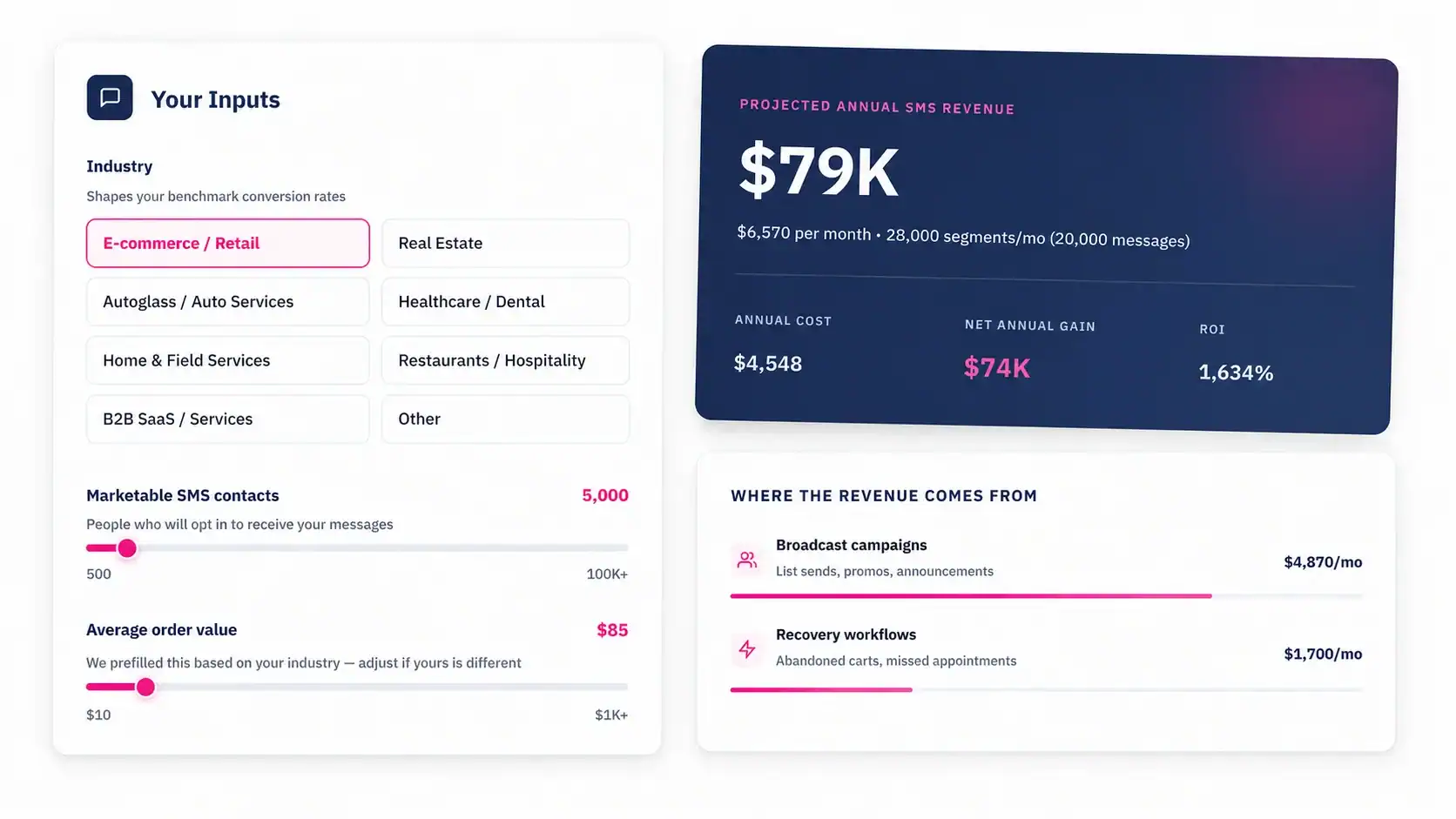
The Bottom Line
The cost of SMS marketing vs email is not a simple comparison. Per-message, email is cheaper. Per-conversion, SMS often wins, especially for urgent, time-sensitive, or reply-based workflows. Email wins on scale, content depth, and frequency tolerance. SMS wins on open rate, response rate, and speed-to-action.
The right answer for most B2B teams is not choosing between them. It’s sequencing SMS for the moments that need immediate attention and email for the moments that need explanation. Both together, triggered from HubSpot, produce results that neither channel achieves alone.
If you’re running HubSpot and want to add SMS without adding another tool to manage, try Message IQ free. Plans start at $49/mo and your first HubSpot SMS workflow can be running in under 10 minutes.