

As 2026 winds down, SMS marketing has cemented itself as the strongest direct channel businesses have. The stats are in and they don’t leave much room for debate. Text messaging reaches customers where they already are, and the ROI numbers back it up.
Here’s what the 2026 data shows, and what it means for your SMS marketing plan heading into 2027.
Reach and Engagement Are Solid
SMS continues to dominate email with a 98% open rate, compared to roughly 20-30% for email, which means your texts are practically guaranteed to get seen while most of your email list never opens the message at all. That’s not surprising given over 95% of Americans own a smartphone and check it an average of 47 times a day. People aren’t just seeing your message, they’re acting on it. SMS pulls a 45% average response rate, dwarfing the single-digit rates most other channels settle for.
Conversions and ROI Are Strong
Getting a message seen is one thing. Getting it to convert is the part that actually matters. SMS messages run click-through rates of 19%, compared to about 3% for email and 0.5-2% for social. That gap shows up directly in revenue: 52% of consumers have made a purchase as a direct result of an SMS marketing message. And for every dollar spent on SMS, businesses generate $71 on average, which makes it one of the highest-ROI channels available to a marketing team right now.
Consumer Preference Is Positive
Brands worry they’re bothering people by texting them. The data says otherwise. 70% of consumers opt in to SMS communications from brands, and 91% overall are fine with receiving them. 66% of consumers now prefer mobile messaging or rank it as their second choice for business communication. The question isn’t whether customers are okay with SMS anymore. It’s why your team hasn’t built it into the funnel yet.
SMS vs. Email: The Side-by-Side
| Metric | SMS | |
|---|---|---|
| Open rate | 98% | 20-30% |
| Response rate | 45% | Under 10% |
| Click-through rate | 19% | ~3% |
| Avg. ROI per $1 spent | $71 | Lower, channel-dependent |
| Best use case | Time-sensitive, action-driven | Long-form, low-urgency content |
Email still has a place for newsletters and detailed content. But anything that needs a reply within the hour belongs in SMS, not an inbox that gets checked twice a day. Most teams running both end up pairing SMS with email rather than replacing it, using SMS for the moments that need speed.
Putting This Into a HubSpot Workflow
The stats only matter if they turn into a process your team can actually run. Here’s how a basic speed-to-lead workflow looks inside HubSpot once Message IQ is connected:
- Enrollment trigger: Contact submits a demo request or pricing form
- Action: Message IQ sends an SMS via the HubSpot workflow action
- Delay: Wait 10 minutes for a reply
- Branch logic: If the contact replies, assign to the rep on duty. If not, send a follow-up SMS 24 hours later
That’s it. No separate platform, no exporting contacts, no manual texting from a personal phone. The trigger lives on the contact record where your team already works.
Three SMS Templates to Start With
Use case: Speed-to-lead follow-up
“Hi {{first_name}}, saw you checked out MessageIQ. Happy to walk through how it works inside your HubSpot in 15 minutes. Reply to grab a time. — {{rep_name}}” (148 chars)
Use case: Re-engagement after no reply
“Hi {{first_name}}, following up on SMS for {{company}}. Still want a quick walkthrough? Reply YES and we’ll find a time this week.” (130 chars)
Use case: Appointment confirmation
“Reminder: your call with {{rep_name}} is tomorrow at 2pm. Reply CONFIRM or call us to reschedule.” (100 chars)
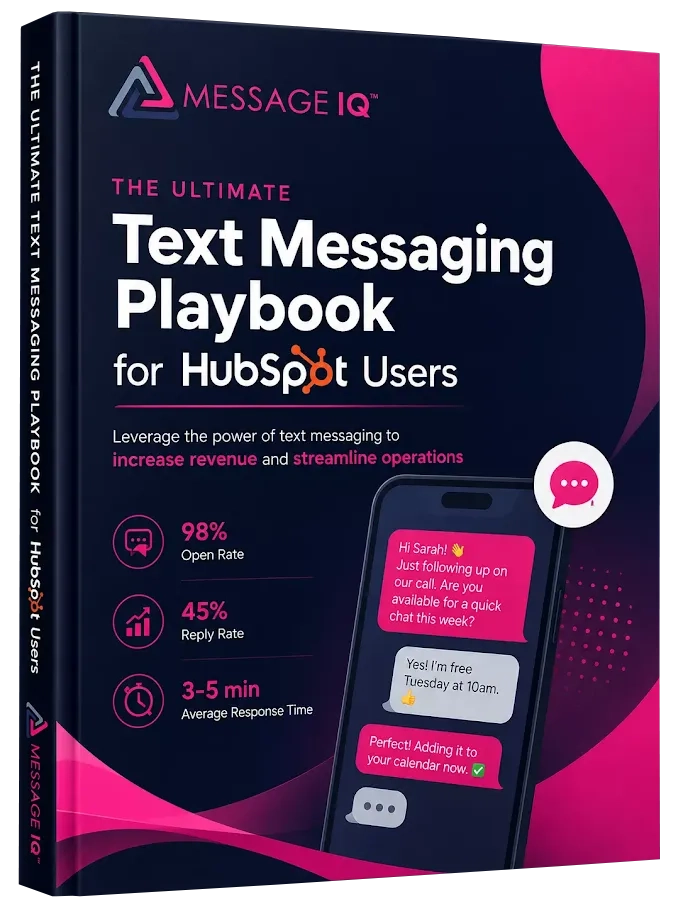
Get Your Ultimate HubSpot Text Messaging Playbook for FREE
Discover how top HubSpot teams use SMS to boost engagement, close deals faster and streamline operations.
Instant download
Expert insights from certified HubSpot professionals
Ultimate Text Messaging Playbook
Staying TCPA Compliant While You Scale
None of this works if your opt-in process is sloppy. The TCPA requires written consent before you send marketing texts, and carriers are filtering harder for unregistered senders than they were a year ago. That means 10DLC brand and campaign registration isn’t optional anymore if you’re sending at any real volume. MessageIQ handles opt-in capture, opt-out keywords, and consent tracking inside HubSpot natively, so your sales and marketing teams aren’t managing compliance in a spreadsheet on the side.
What’s to Come in 2027
The 2026 numbers paint a clear picture. SMS grabbed attention, drove engagement, and converted customers at a rate email simply can’t match. That trend isn’t slowing down. The teams that win in 2027 will be the ones using customer data and AI-driven personalization to make every text feel relevant instead of generic. Interactive content and video messages are also gaining traction, and businesses that build those into their SMS strategy now will have a head start once they go mainstream.
SMS has earned its place as a core marketing channel in a mobile-first world. But the technology only works if the message still feels human. Keep it personal, keep it relevant, and the open rates and response rates take care of themselves.
FAQ : sms marketing crushed
Does SMS marketing still work in 2026 if my list is small?
Yes. SMS performance doesn’t depend on list size the way email does. A list of 200 engaged contacts with a 45% response rate will outperform a 10,000-person email list with single-digit engagement, especially for time-sensitive offers.
Do I need a separate platform to send SMS from HubSpot?
No, not with a native integration. Message IQ sends and receives texts directly through HubSpot workflows and contact records, so your team isn’t switching tools or exporting lists.
Is texting customers without consent legal?
No. The TCPA requires prior written consent for marketing texts, and skipping this step risks fines and carrier suspension. MessageIQ builds opt-in and opt-out handling into the platform so consent is tracked automatically.
What’s a realistic response rate to expect from SMS?
Industry data shows an average response rate around 45%, though this varies by industry and message relevance. Even a conservative campaign should outperform email response rates by a wide margin.
Should I replace email with SMS entirely?
No. SMS works best for time-sensitive, action-driven messages, while email still handles longer-form content well. Most successful teams run both channels together rather than picking one.
See how much revenue SMS could add to your HubSpot stack
Five inputs. Industry-backed benchmarks. Get your projected annual SMS revenue in under 30 seconds.
Calculate My SMS ROI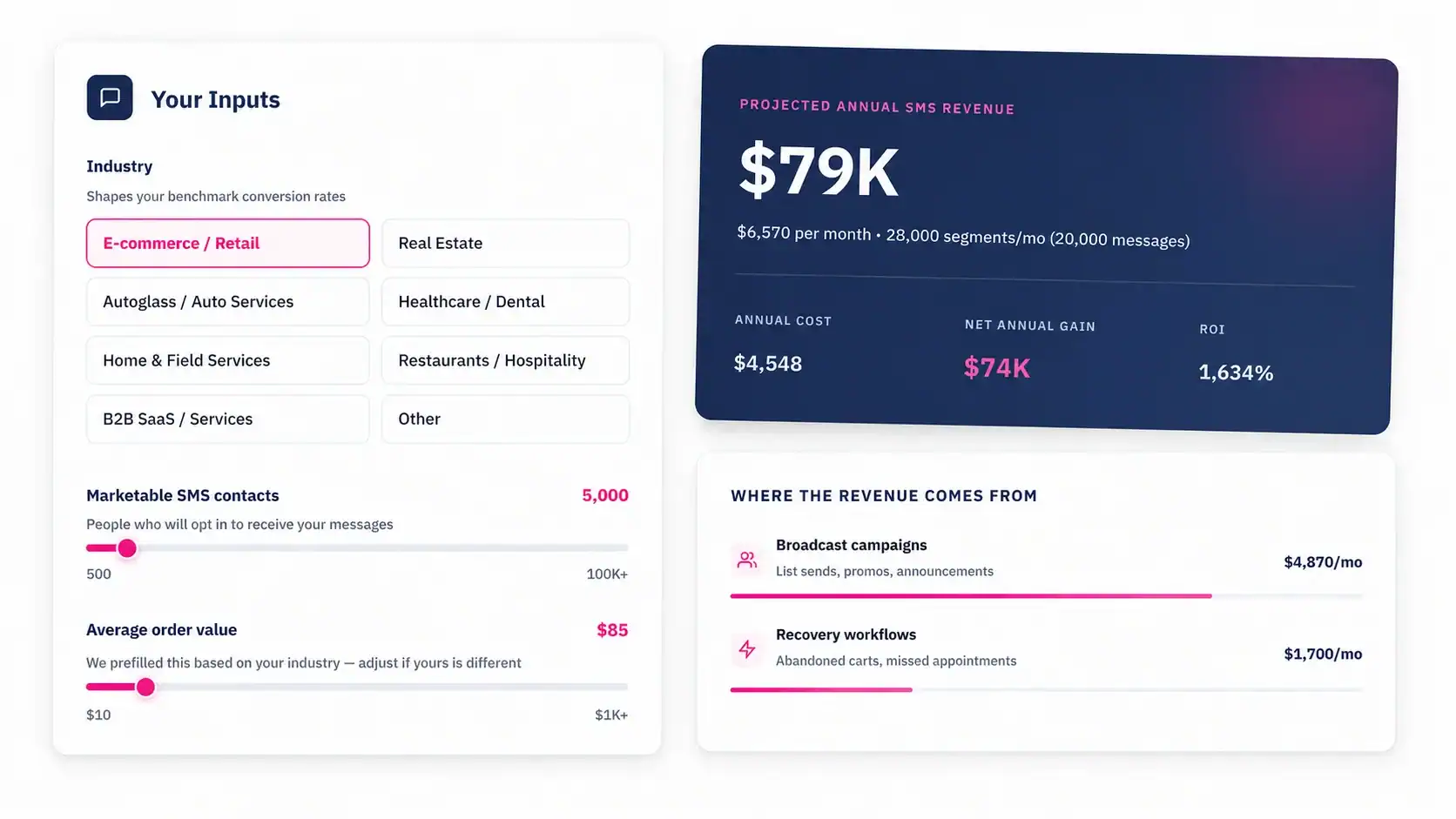
Get Your 2027 SMS Plan Underway
Building this out manually across spreadsheets and a separate texting app is where most teams lose momentum. Message IQ plugs straight into your existing HubSpot workflows, with plans starting at $99/mo. See how it connects to your HubSpot in under 10 minutes.