

98% of text messages get opened, versus roughly 20% for email, so it’s no mystery why every business wants the channel and why so many start by hunting for a free business text messaging service. The honest answer up front: free routes exist, four of them, and every one trades away something a growing company eventually needs. We’ll walk through all four, show you where each one caps out, and give you the math for the moment paid starts beating free.
We build Message IQ, a two-way SMS platform with the deepest native HubSpot integration in the Marketplace, so we obviously have a horse in this race. That’s exactly why we’re not going to tell you free never works. It does, for specific situations, and knowing which situation you’re in saves you either money or a compliance headache.
Book a Free Demo
What Is a Business Text Messaging Service?
A business text messaging service is a platform that lets a company send and receive SMS and MMS from a dedicated business number instead of an employee’s personal phone. The real product isn’t the text itself; it’s everything wrapped around it: a shared team inbox, automation, CRM logging, opt-out management, and A2P 10DLC carrier registration.
Hold that list in your head as you read the free options below, because it’s the exact list every free route strips away. Text messaging for business works as a channel when replies land somewhere your whole team can see and every consent decision gets recorded. A message that arrives free but vanishes into one person’s browser tab isn’t a channel, it’s a loose end. Keep that bar in mind: the question isn’t whether a free tool can send a text, it’s whether it can run business texting as an accountable channel.
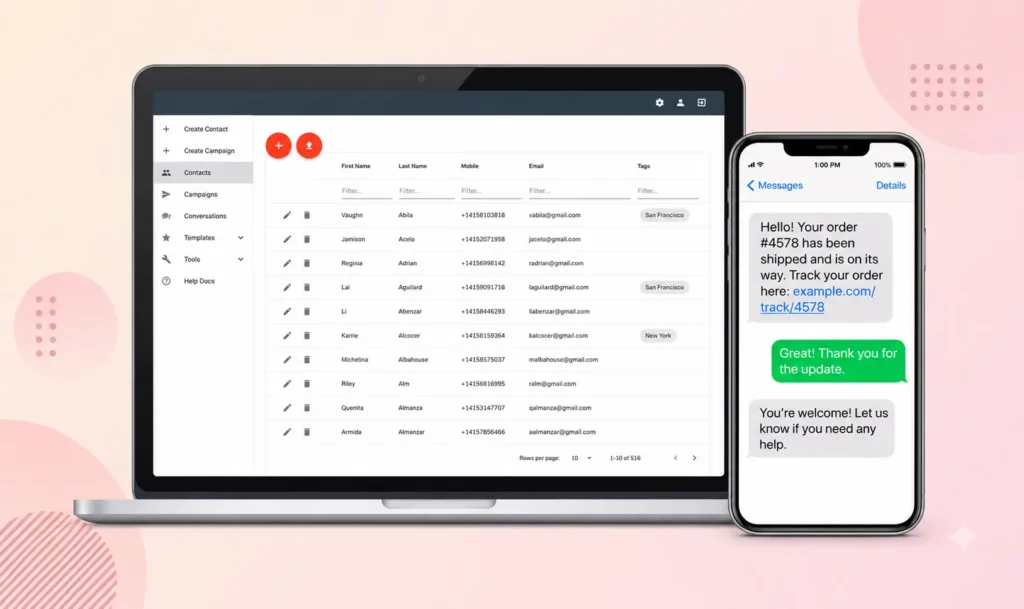
4 Ways to Get a Free Business Text Messaging Service
Each of these costs nothing in dollars. What they cost you instead is scale, compliance, or your team’s time, and the split matters more than the price tag.
1. Free Trials of Paid SMS Platforms
Every credible platform hands new accounts a temporary number and a bundle of test messages at no charge. This is the only free route that gives you the actual business product: real deliverability, a real inbox, real automation.
The catch: it’s free with an expiration date, usually 14 days or a fixed message count. Works if you treat the trial as a structured evaluation: send tests across AT&T, Verizon, and T-Mobile numbers, hold a genuine two-way conversation, and wire up one automation end to end. Breaks when you try to string trials together as a permanent plan, because carrier registration doesn’t transfer and your number changes every time, which torches the customer experience.
2. Email-to-SMS Carrier Gateways
Some mobile carriers run gateways that convert an email into a text. Address an email to the recipient’s ten-digit number at the carrier’s gateway domain, keep it short, hit send and it lands as an SMS. T-Mobile and Verizon still operate gateways; AT&T has already retired its email-to-text gateway entirely, and more shutdowns are likely because carriers treat these as spam funnels.
The catch: you have to know each contact’s carrier, which you almost never do, and there’s no opt-out handling, no delivery confirmation, and no record of consent. Works if you’re texting a handful of employees whose carriers you know, for internal alerts nobody opted out of because they asked for them. Breaks when you point it at customers, because a marketing message with no STOP mechanism is a TCPA violation waiting for a plaintiff’s attorney.
3. Free Online SMS Websites
Browser tools that send one-off texts at no cost still exist, propped up by ads and data collection. No installation, no account in some cases, type and send.
The catch: delivery is slow and unverifiable, the sender number isn’t yours, replies go nowhere you can see, and you’re handing customer phone numbers to a site with an unknown privacy policy. Works if you need to send one text, once, and don’t care about a reply. Breaks when you need anything a business needs: a consistent number, a conversation thread, or proof the message arrived. Treating one of these as a mass text messaging service is how contact lists end up in spam databases.
4. Google Voice
Google Voice gives you a free real phone number that sends and receives individual texts and calls from a clean app. Of the four free routes, it’s the only one that resembles an actual phone line your business owns.
The catch: it’s built for a person, not a team. One inbox, one login, no shared visibility, no automation, no CRM logging, and Google restricts automated or bulk sending, so there’s no path to registered A2P traffic. Works if you’re a sole proprietor answering a few customer texts a week and you want them off your personal number. Breaks when you hire your first teammate or need a workflow to send anything automatically.
Side by side, the trade-offs look like this:
| Free route | Real cost | Handles replies? | Compliance cover | Best for |
|---|---|---|---|---|
| Platform free trial | Time-boxed; ends in paid plan | Yes, shared inbox | Full, while it lasts | Evaluating before buying |
| Carrier email gateway | Manual effort per message | Poorly, via email | None | Internal alerts to known carriers |
| Free SMS websites | Your data and your contacts’ privacy | No | None | A single throwaway text |
| Google Voice | No team, no automation | One person only | None for A2P | Sole proprietors at low volume |
Why Every Free Route Hits the Same Wall: 10DLC and TCPA
Two rule sets explain why no permanent free business texting exists at any real volume. A2P 10DLC requires every company sending application-to-person texts over local numbers to complete paid brand and campaign registration with carriers. Registration has one-time and recurring fees, approval takes two to four weeks, and unregistered traffic gets filtered or blocked. No free route includes it, which is why free methods choke past a trickle of messages.
The TCPA is the legal side. Marketing texts require prior express written consent, violations run $500 to $1,500 per message, and every STOP reply must be honored instantly across everything you send. Gateways, free SMS sites, and Google Voice give you zero infrastructure for consent capture and opt-out language, so the free options aren’t just limited, they leave the compliance burden entirely on you with no tooling. A 1,000-contact blast without documented consent is a seven-figure exposure, sent for free.
Free or Paid: How to Choose Based on What You Actually Send
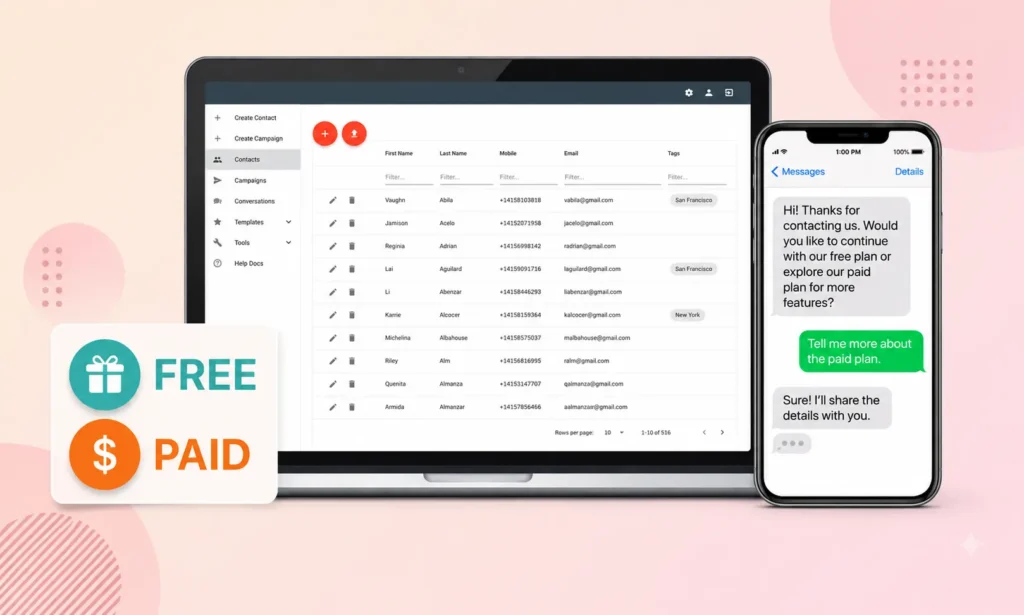
Whether free text messaging for business is enough for you comes down to five factors, and you can score yourself against them in ten minutes:
- Message volume. Sending a few individual texts a month? Google Voice covers it. Sending campaigns, reminders, or anything approaching bulk? You need registered 10DLC traffic, and that means a paid platform. There’s no free tier of carrier trust.
- Personalization. Free routes send flat text. A paid platform fills merge fields from your CRM, so “Hi Jeff, your appointment is Tuesday at 2” goes to 400 people with 400 names and times, without anyone typing them.
- Reply handling. This is the sharpest dividing line. If customer replies drive revenue, which covers sales follow-up, scheduling, and support, you need two-way business texting with a shared inbox your team can work from. Every free route except a platform trial fails this test outright.
- CRM integration. If a text isn’t logged on the contact record, it didn’t happen as far as your reporting is concerned. Free routes log nothing. Paid platforms write every send and reply to the timeline, which is where SMS automation becomes possible.
- Compliance exposure. Texting customers at all puts you under the TCPA. If you can’t document opt-ins and process opt-outs automatically, your free channel carries more legal risk than the subscription you’re avoiding costs.
Score two or more factors toward the paid column and the free hunt is costing you more than it saves. Score all five toward free, meaning tiny volume, no personalization, no replies, no CRM, no marketing content, and a free route genuinely fits. That describes very few businesses for very long.
Get Your Ultimate HubSpot Text Messaging Playbook for FREE
Discover how top HubSpot teams use SMS to boost engagement, close deals faster and streamline operations.
Instant download
Expert insights from certified HubSpot professionals
Ultimate Text Messaging Playbook
Five Signs You’ve Outgrown Free Business Texting
Free routes rarely fail loudly. They fail through small daily frictions that compound, and these five are the reliable tells:
- Two people asked “did anyone reply to that customer?” in the same week. That question means conversations live in one person’s app, and you need the shared inbox that comes with two-way business texting.
- You copy-pasted the same message more than ten times. Repetition at that scale is a workflow, and workflows need automation and merge fields, neither of which any free route offers.
- You wanted to text a list. The moment a send goes one-to-many, you’re in mass text messaging service territory, which means registered traffic, opt-out handling, and consent records or filtered messages and legal exposure.
- A customer said they never got your text. Free routes give you no delivery reporting, so you can’t tell a carrier block from a typo. Paid platforms show you delivery status per message.
- Someone asked what SMS is doing for revenue. If you can’t answer because nothing logs to the CRM, the channel is invisible in reporting, and invisible channels get cut in budget season, fairly or not.
What Paid Business Texting Costs When Free Runs Out
Entry plans across the market run $19 to $39 per month, but compare the pricing model, not the sticker. Credit-based plans expire unused messages monthly and stack telecom surcharges and per-seat fees on top; a $25 plan for a five-person team sending 2,000 messages routinely lands over $90 once overages and extra seats hit.
Flat and autoscaling models keep the number predictable. Message IQ starts at $49 per month on month-to-month plans with autoscaling that keeps you on one phone number regardless of volume, and 10DLC registration guidance is part of onboarding rather than your research project.
Against the hidden costs of free, which are manual effort, zero consent records, and a number you don’t control, a predictable business SMS service bill is usually the cheaper option by month two.
The pattern we see across new accounts runs about 90 days. A team starts on Google Voice or a gateway hack, hits one of the five signs above within a month, runs a platform trial in month two, and is fully on paid SMS for business by month three, usually after one automation proves itself. Skipping straight to the trial saves the first sixty days, and the trial itself is free either way.
The Smart Free Play: Trial SMS for Business Inside Your HubSpot
If your company runs on HubSpot, route one, the platform trial, gets dramatically more useful, because you can test the real thing inside the CRM you already use.
Message IQ was built HubSpot-first by HubSpot Diamond Solutions Partners (Integrate IQ), whose ecosystem spans 300+ platform integrations, and this is the ten-minute workflow we tell every trial account to build before deciding anything:
- Enrollment trigger: Contact submits the “Request a Demo” form.
- Action: Message IQ sends a personalized SMS through the HubSpot workflow action within 90 seconds of the form fill, while the lead is still on your site.
- Delay: Wait 10 minutes.
- Branch logic: If the contact replied, create a task and assign the conversation to their owner. If not, send one follow-up SMS after 24 hours, then stop.
That’s the speed-to-lead play, the highest-converting SMS use we see, and no free route can run it because it needs automation, a shared inbox, and timeline logging all at once. Build it during a trial and you’ll know within a week whether the channel pays for itself, using real leads instead of a feature checklist.
Frequently Asked Questions
Is there a truly free business text messaging service?
No permanent one exists at business volume. Free trials, carrier email gateways, free SMS websites, and Google Voice all work in narrow situations, but every company sending real volume must complete paid A2P 10DLC registration, and no free route includes it. Anything marketed as unlimited free business texting is either non-compliant or monetizing you another way.
What is the best free way to send business texts?
A free trial of a paid platform, because it’s the only option that includes deliverability, a shared inbox, automation, and compliance tooling. Use the trial window to test delivery across carriers and build one real automation, then decide with data instead of a feature list.
Is Google Voice good enough for business texting?
For a sole proprietor sending and receiving a few texts a week, yes. Beyond that, no. There’s one inbox and one login, no automation, no CRM logging, and no path to registered bulk traffic, so it stops fitting the moment a second person needs to see conversations.
Do free texting methods need 10DLC registration?
The registration requirement attaches to application-to-person traffic, which is why free methods either avoid it by staying tiny or simply operate outside carrier rules and get filtered. Any business sending campaigns or automated texts over local numbers needs registered 10DLC traffic, and that always involves fees.
How much does a paid business text messaging service cost?
Entry plans run $19 to $39 per month across most of the market, with MessageIQ starting at $49 per month on month-to-month terms. Model your real volume against overage rates, per-seat fees, and telecom surcharges before comparing sticker prices, because credit-based plans routinely double once a team actually uses them.
What’s the best business SMS service for HubSpot users?
A HubSpot-native platform beats a generic tool with a connector, because texts trigger directly from workflows and every message logs to the contact timeline. Message IQ was built HubSpot-first by Diamond Solutions Partners and offers the deepest native integration in the Marketplace, starting at $49 per month.
Start Free the Smart Way
You came here to text customers without spending money, and the best version of that is a trial of the real thing rather than a workaround that leaks compliance risk. Message IQ is two-way by default, handles TCPA opt-outs and 10DLC registration for you, and lives natively inside HubSpot, with plans from $49 per month when you’re ready. See how MessageIQ connects to your HubSpot in under 10 minutes.
See how much revenue SMS could add to your HubSpot stack
Five inputs. Industry-backed benchmarks. Get your projected annual SMS revenue in under 30 seconds.
Calculate My SMS ROI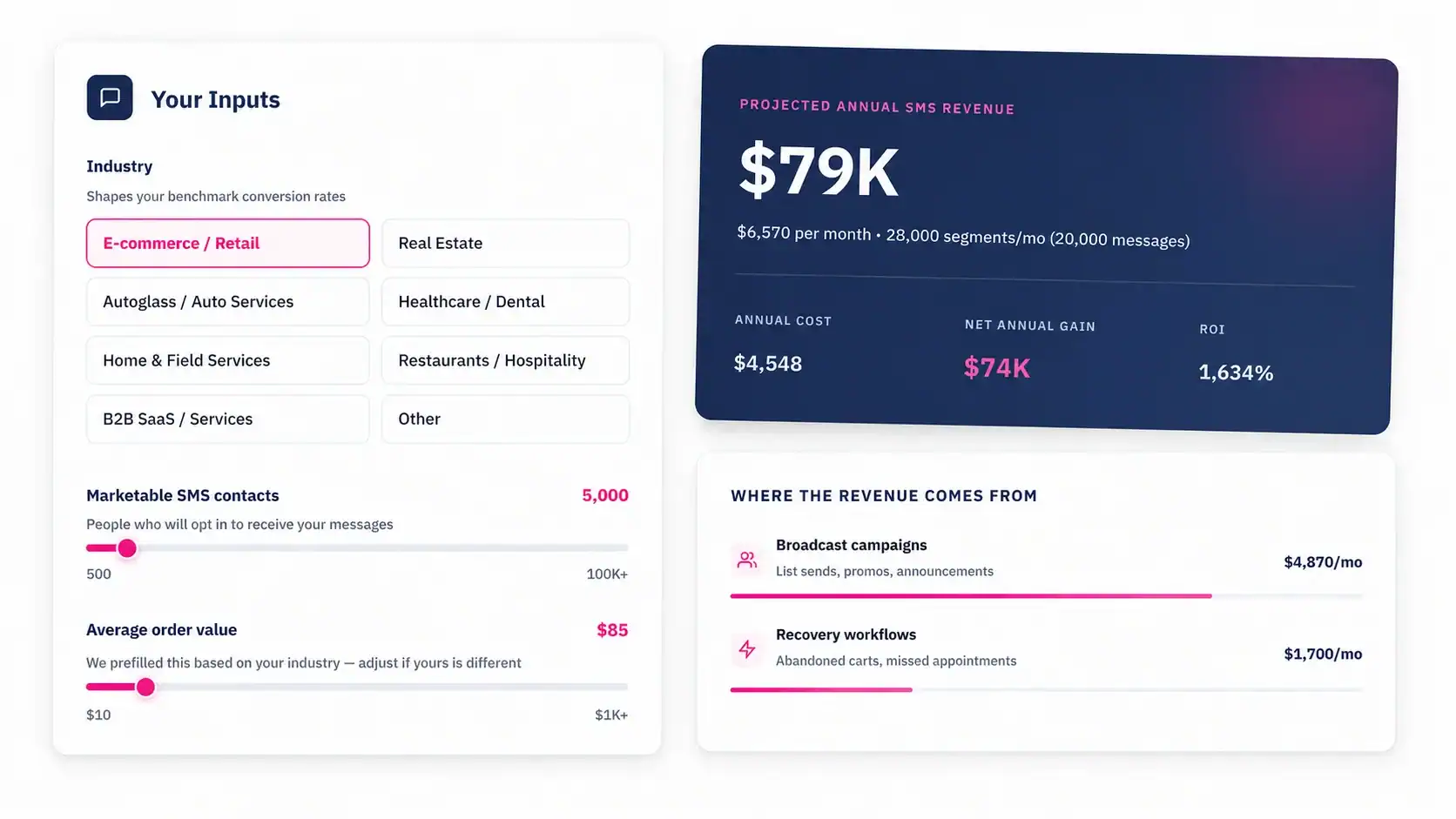
Talk to an Expert