

Picking an SMS marketing pricing model feels like a small decision until you’re locked into an annual contract with a platform that doesn’t connect properly to HubSpot, charges extra for two-way messaging, and won’t let you cancel without a penalty. The choice between SMS marketing month to month no contract and annual plans directly affects your budget flexibility, your per-message rate, and your ability to switch platforms if the tool stops working for your team.
Here’s the honest breakdown, including where each model makes financial sense and where it costs you more than you expect.
What Is SMS Marketing Month to Month No Contract?
SMS marketing month to month no contract means you pay a flat monthly fee or per-message rate with no annual commitment required. You can cancel, downgrade, or switch platforms at the end of any billing cycle without penalty fees or locked-in credits.
Most month-to-month SMS plans charge a slightly higher monthly rate than equivalent annual plans in exchange for that flexibility. The premium is typically 15 to 20% more per month. For teams still validating SMS as a channel or running seasonal campaigns, that flexibility premium often costs far less than a year committed to the wrong platform.
MessageIQ offers month-to-month pricing starting at $99/mo with no long-term contracts required. Two-way SMS, a shared team inbox, and TCPA-compliant opt-in/opt-out are included by default, not locked behind a higher tier.
See how much revenue SMS could add to your HubSpot stack
Five inputs. Industry-backed benchmarks. Get your projected annual SMS revenue in under 30 seconds.
Calculate My SMS ROI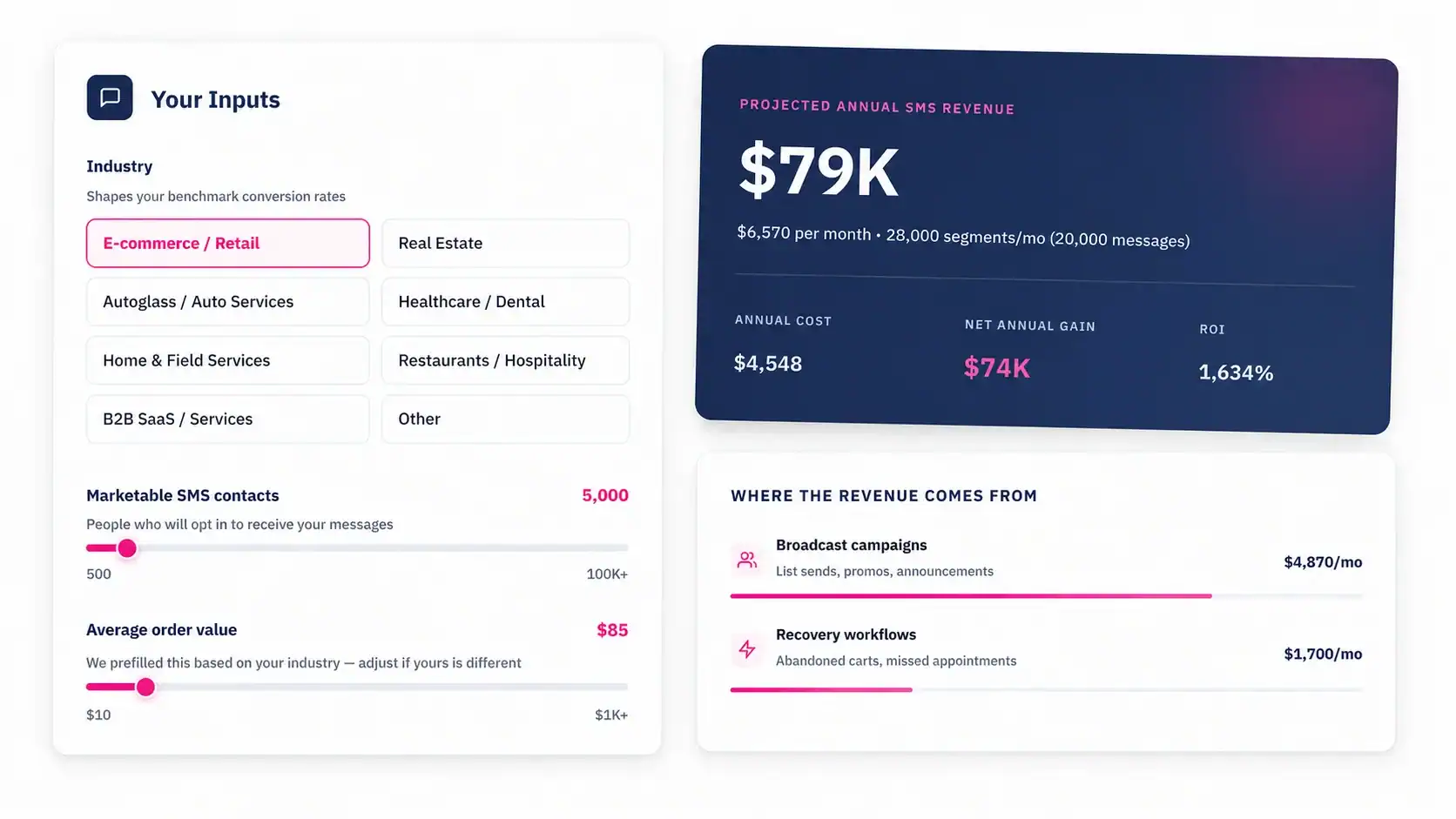
The Real Cost Difference: Month to Month vs Annual
Before comparing models, you need to understand what you’re actually paying for. Most platforms show a per-message rate on their pricing page. That number rarely reflects your full monthly spend.
What Goes Into Your Total Monthly Cost
- Platform subscription fee: The base monthly rate for access to the tool
- Per-message charges: Cost per outgoing SMS ($0.01 to $0.05 in the US for standard SMS)
- MMS charges: Image or media messages typically cost $0.02 to $0.08 each
- 10DLC registration: A2P brand registration ($4 to $20 one-time) plus campaign registration ($10 to $25/month per campaign)
- Inbound message fees: Some platforms charge $0.01 per reply received. If you run two-way campaigns at volume, this adds up fast.
- Overage rates: Per-message rate once you exceed your monthly credit allowance, often 20 to 40% higher than your plan rate
- Feature add-ons: Automation, segmentation, and advanced analytics are often gated behind higher tiers or charged separately
The platform that looks cheapest at $39/month often lands at $150 to $250/month once inbound fees, overage charges, and add-ons are included. Always calculate total monthly cost, not just the advertised plan rate. See our detailed HubSpot SMS pricing guide for a full platform comparison.
Side-by-Side Cost Comparison
| Factor | Month to Month No Contract | Annual Plan |
| Monthly rate premium | 15-20% higher | Base rate |
| Annual discount | None | Typically 15-20% off |
| Cancellation flexibility | Cancel anytime | Early termination fees or forfeit remaining months |
| Upfront commitment | None | 12 months of fees |
| Credit expiry | Varies by platform | Often use-it-or-lose-it annually |
| Platform switch cost | Low: exit end of month | High: sunk cost if you leave early |
| Budget predictability | Moderate | High |
| Best for | New programs, seasonal use, testing | Established high-volume programs |
When Month to Month No Contract Makes More Financial Sense
You’re Running a New SMS Program
If you haven’t proven ROI on SMS yet, locking into an annual contract is a real budget risk. A month-to-month plan lets you run 2 to 3 months of campaigns, measure results against your HubSpot contact data, and make a contract decision from evidence rather than a sales call.
SMS marketing automated workflows generate roughly $0.74 per send compared to $0.15 for one-off campaign messages. But you need to set those workflows up first, test them against your funnel, and verify the numbers hold in your specific HubSpot environment before committing to annual pricing. Our guide to SMS automation in HubSpot covers exactly how to build those workflows so you’re not flying blind during a trial period.
Your Volume Is Unpredictable or Seasonal
A retail business running holiday campaigns, a real estate team that sends heavier volume during spring and fall, or a service business with seasonal appointment spikes all have variable SMS needs. Annual plans lock you into a message volume tier. If you over-buy, you’re paying for credits you don’t use. If you under-buy, you’re paying overage rates that spike your monthly cost.
Month-to-month plans let you scale up and down each billing cycle without penalty.
You’re Evaluating Platform Fit
Not every SMS platform connects natively to HubSpot. Most require a Zapier integration or a third-party connector that breaks when HubSpot updates its API. Signing an annual contract before verifying that SMS sends, replies, and opt-outs actually log to HubSpot contact records is a common, expensive mistake.
With a month-to-month plan, you can test the full integration, including enrollment triggers, contact property updates, and branch logic in your HubSpot workflows, before you commit a year of budget.
When Annual Plans Make More Financial Sense
You Send High Volume Consistently
If your team sends 10,000 or more messages per month with predictable consistency, the math on annual plans improves significantly. A 20% annual discount on a $239/month plan saves $573 over the year. At high enough volume, that saving funds additional campaigns or offsets other marketing costs.
The break-even point is typically around month 7 to 8 of an annual plan. If you’re confident the platform fits your HubSpot workflows and your message volume is stable, the annual discount is real money.
Your Platform Integration Is Proven
Once you’ve confirmed that your SMS platform connects properly to HubSpot natively, fires workflow actions correctly on enrollment triggers, logs two-way conversations to contact timelines, and handles TCPA opt-outs automatically, there’s less reason to pay the month-to-month premium. You’ve de-risked the decision.
MessageIQ is built by HubSpot Diamond Solutions Partners (IntegrateIQ), which means the HubSpot connection is built into the core product rather than bolted on. Every SMS send, reply, and opt-out logs natively to HubSpot. That’s the kind of verified integration that makes an annual plan a safe commitment rather than a gamble. See how the HubSpot SMS integration works end to end.
You Need Budget Predictability for Finance Sign-Off
Annual plans make it easier to get SMS marketing approved as a line item. A fixed annual commitment is a cleaner budget conversation than a variable monthly charge that fluctuates with campaign volume. If you’re in a company where finance reviews monthly SaaS spend closely, an annual contract often reduces friction.
Hidden Costs That Change the Calculation
Several costs appear after you sign up that rarely show up in pricing page comparisons. These matter more than the monthly rate difference between plan types.
Inbound Message Fees
Two-way SMS is the most effective way to run SMS marketing. 98% of SMS messages are opened vs roughly 20% for email, and a meaningful percentage of those recipients reply. If your platform charges $0.01 per inbound message and you’re running active two-way campaigns, inbound fees add up to real monthly spend. Always check whether inbound messages are included or billed separately.
MessageIQ includes two-way SMS by default on every plan, with inbound messages handled through a shared team inbox for sales and support. There’s no separate charge for conversations your team actually needs to manage.
Overage Rates
Most tiered plans charge a per-message overage rate when you exceed your monthly credit allowance. These rates are typically 20 to 40% higher than your plan’s included per-message rate. A campaign that performs better than expected (more sends, more replies) can push you into overage territory and double your effective per-message cost for that month.
Before signing any plan, annual or monthly, confirm the overage rate and set up monitoring inside HubSpot to track send volume against your monthly allowance.
Feature Lock-In
Many SMS platforms gate automation, segmentation, and analytics behind higher-tier plans. If you sign an annual contract on a base plan and then discover that HubSpot workflow triggers require the next tier up, you’re either paying for an upgrade or stuck with a tool that doesn’t do what you need it to.
Before signing, test every HubSpot workflow action you plan to use, including enrollment triggers, delay steps, branch logic, and contact property updates, on the exact plan tier you’re budgeting for.
10DLC Registration Fees
A2P 10DLC brand and campaign registration is required for US business SMS. These are fixed costs regardless of your plan type: brand registration runs $4 to $20 one-time, and campaign registration runs $10 to $25 per month per campaign type. They apply whether you’re on a month-to-month plan or an annual contract. Build them into your cost model before comparing plans. For the full registration walkthrough, see our A2P 10DLC brand registration guide.
Turn HubSpot Into A Real-Time SMS Engine with Message IQ
 Two-Way Conversations
 Shared Team Inbox
 Automation Triggers
 Advanced Reporting
 Compliance Tools
- 98% SMS read within 3 min
- 78% Buy from first responder
- 21× More likely to qualify

*MessageIQ is an Integrate IQ product built natively for HubSpot by the same team.
SMS Templates to Test During Your Trial Period
If you’re on a month-to-month plan and running your first campaigns, these templates give you strong signals on engagement and conversion before you commit to annual pricing.
Use case: Speed-to-lead follow-up
“Hi {{first_name}}, thanks for reaching out to {{company}}. Quick question before we connect: what’s your biggest challenge with SMS right now? Reply here. — {{rep_name}}” (170 chars)
Use case: Appointment confirmation
“Hi {{first_name}}, confirming your appointment tomorrow at [time] with {{rep_name}}. Reply YES to confirm or NO to reschedule. We’ll adjust right away.” (151 chars)
Use case: Re-engagement campaign
“Hi {{first_name}}, it’s been a while. We have something new that’s relevant to {{company}}. Want a quick look? Reply YES and we’ll send details. — {{rep_name}}” (161 chars)
Use these in your first month of HubSpot workflows to generate reply rate and conversion data. That data is what tells you whether the platform and plan structure are worth a longer commitment. Browse more options in our SMS templates library.
HubSpot Workflow: Testing ROI Before Committing to Annual
Here’s a simple HubSpot workflow you can run during a month-to-month trial to measure SMS performance cleanly.
Use case: New lead SMS vs email split test
- Enrollment trigger: Contact submits any lead form with a mobile phone number present
- Branch logic: If contact is in list “SMS Test Group” (random 50% of new leads), proceed to SMS step. If not, proceed to email step.
- Action (SMS branch): MessageIQ sends SMS within 5 minutes via HubSpot workflow action using the speed-to-lead template above
- Action (email branch): HubSpot sends standard lead follow-up email sequence
- Delay: Wait 48 hours
- Action: Update contact property “First Contact Channel” to SMS or Email based on branch taken
- Goal: Meeting booked or demo requested within 7 days
Run this for 30 days. Compare meeting-booked rate by channel against your cost per send for each group. That gives you a real ROI number to take into an annual plan conversation, or to justify staying month-to-month if the numbers aren’t there yet.
TCPA Compliance Regardless of Plan Type
One thing that doesn’t change based on your pricing model is TCPA compliance. You need prior express written consent before sending marketing SMS to any contact, whether you’re on a $99/month plan or a $500/month enterprise contract.
The legal exposure is significant: $500 per violation for negligent TCPA violations, up to $1,500 per willful violation. A non-compliant campaign to 5,000 contacts creates massive liability regardless of how flexible your pricing plan is.
Every MessageIQ plan includes TCPA-compliant opt-in and opt-out handling built in. STOP, QUIT, and UNSUBSCRIBE replies are processed automatically and logged to HubSpot contact records. You’re not managing compliance manually on top of a generic SMS tool.
For the full compliance framework, start with our TCPA consent language guide and review the SMS compliance checklist for marketing teams before your first send.
Frequently Asked Questions
What is SMS marketing month to month no contract?
It’s a pricing model where you pay for SMS marketing on a monthly basis with no annual commitment. You can cancel, downgrade, or switch platforms at the end of any billing cycle without penalty. You typically pay 15 to 20% more per month compared to an equivalent annual plan in exchange for that flexibility.
Is month-to-month SMS marketing more expensive than annual plans?
Per month, yes. Month-to-month plans typically cost 15 to 20% more than the equivalent annual plan rate. Over 12 months, that premium adds up. The calculation flips when you factor in the risk of paying for a full year on a platform that doesn’t integrate properly with HubSpot or doesn’t produce the ROI you need. For new programs, the flexibility premium is often the cheaper option in practice.
What hidden fees should I watch for in SMS marketing plans?
Watch for inbound message fees (charged per reply received), overage rates (per-message cost once you exceed your monthly allowance), feature tier gates (automation and HubSpot workflow actions locked behind higher plans), 10DLC campaign registration fees ($10 to $25/month), and MMS charges separate from standard SMS rates. Always calculate total monthly cost, not just the advertised plan rate.
When should a HubSpot team choose an annual SMS plan?
When you’ve proven that the SMS platform connects natively to HubSpot, your monthly send volume is consistent enough to predict costs, your HubSpot workflows are running correctly on the plan tier you’re buying, and you’ve validated ROI over at least 2 to 3 months. Annual plans make sense as a reward for a proven program, not as the starting point for a new one.
Does MessageIQ offer SMS marketing month to month no contract?
Yes. MessageIQ plans start at $99/mo with no annual contract required. Two-way SMS, TCPA-compliant opt-in and opt-out, a shared team inbox, and native HubSpot integration are all included on every plan. You’re not locked in and you’re not paying add-on fees for core functionality.
What is 10DLC and does it apply to month-to-month SMS plans?
10DLC (10-Digit Long Code) is the A2P registration framework US carriers require for business SMS. It applies to all business SMS programs regardless of your plan type or contract length. Brand registration runs $4 to $20 one-time and campaign registration runs $10 to $25/month per campaign. These are fixed costs that sit outside your platform plan.
Get 300+ SMS Templates
Enter your details to download the PDF instantly.
Download Started!
Your 300+ SMS Templates PDF is downloading now. If it didn’t start, click here.
Which Model Is Right for Your Team?
SMS marketing month to month no contract is the right starting point for most teams. It lets you prove the channel, validate your HubSpot workflows, and build the ROI data you need to justify a longer commitment without betting a full year of budget on an unproven program.
Annual plans become the right move once you’ve got consistent send volume, a platform integration that works exactly the way you need it to inside HubSpot, and 2 to 3 months of campaign data showing returns that justify the spend.
Start month-to-month, run the workflows, look at the numbers. If the ROI is there, the annual discount is yours to take.
If you’re ready to test SMS inside your HubSpot without a contract,try MessageIQ free. Plans from $99/mo, no annual commitment, and your first workflow can be running in under 10 minutes.