
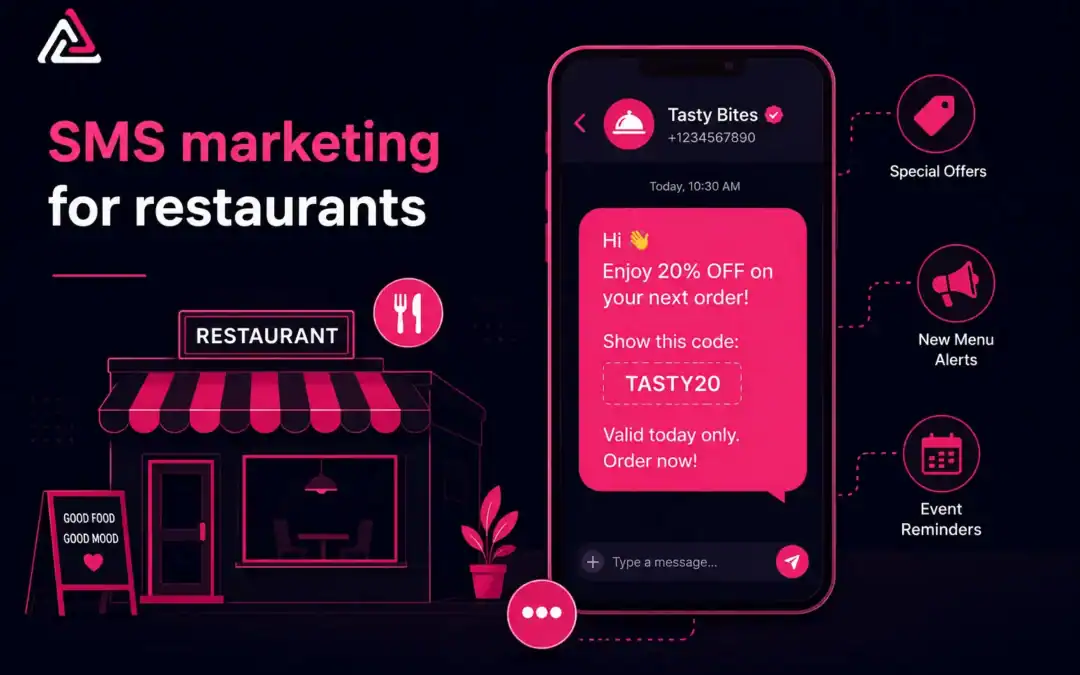
SMS marketing for restaurants helps operators fill slow shifts, reduce no-shows, and build loyal regulars using text messages with 98% open rates. The top use cases are reservation reminders, limited-time promos, loyalty rewards, and post-visit review requests. Messages reach guests in minutes, unlike email that averages just 20% open rates. A compliant setup requires opt-in consent, A2P 10DLC registration, and a business number separate from personal phones.
98% of text messages get read within 3 minutes. Email sits at roughly 20%. If your restaurant’s still relying on email newsletters to bring guests back during slow Tuesday shifts, you’re already losing the attention battle.
SMS marketing for restaurants solves a real, specific problem: hunger is time-sensitive. People decide where to eat in minutes, and whoever reaches them first with the right offer usually wins. A well-timed text promoting tonight’s happy hour or a loyalty reward beats a Facebook post that shows up three days later.
This guide covers every use case that actually works for restaurants in 2026, real message templates you can send this week, how to set up compliant automated workflows, and how to measure ROI. If you’re a multi-location brand or a single independent spot, the same fundamentals apply. And if you’re already running SMS automation in HubSpot, you’ll find a direct workflow walkthrough toward the end.
What Is SMS Marketing for Restaurants?
SMS marketing for restaurants uses text messaging to communicate with guests and drive action, including reservations, online orders, repeat visits, and feedback. Unlike email, texts land in the same inbox people use for personal messages, which is why open rates are 4-5x higher and responses come back in minutes rather than days.
Two-way SMS takes this further. Guests reply to your texts, ask questions, confirm bookings, or request a table. Your team handles it from a shared inbox, and every conversation stays logged, giving you context for every interaction.
See how much revenue SMS could add to your HubSpot stack
Five inputs. Industry-backed benchmarks. Get your projected annual SMS revenue in under 30 seconds.
Calculate My SMS ROI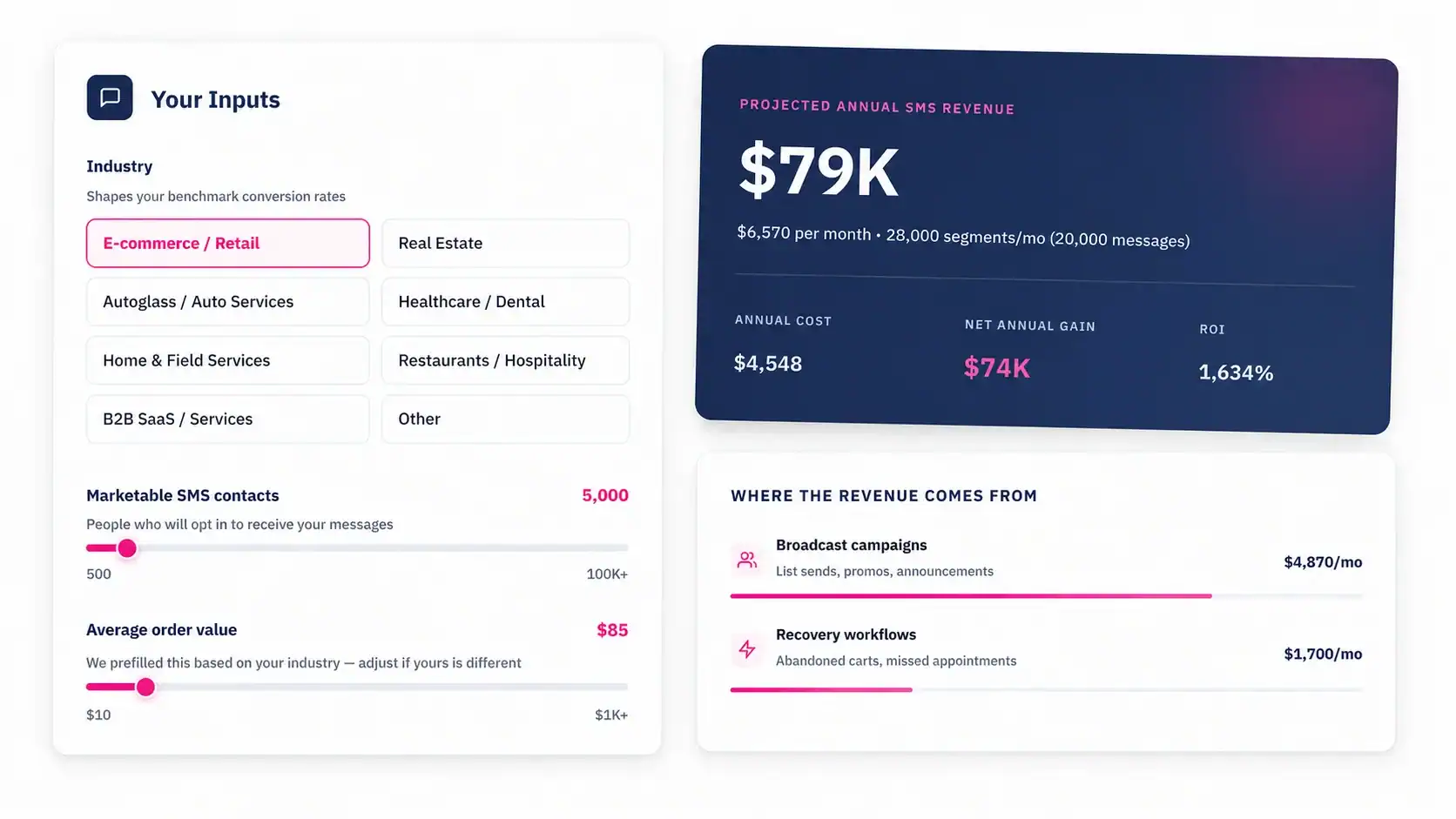
Why SMS Works for Restaurants
Restaurants operate on timing. A dinner reservation that goes unconfirmed is a no-show. A slow Thursday afternoon is a revenue problem you could have solved with a 10am text. SMS fits the industry because the channel itself matches how guests make decisions.
Speed. A text about tonight’s special reaches the inbox immediately, not tomorrow. Guests making evening plans check their phones constantly.
Conversational. Guests can reply, ask about menu options, request modifications, or confirm a booking. That two-way thread builds trust faster than one-way email blasts.
Personal. A message that says ‘Hi Sarah, your table for 4 is confirmed at 7pm tonight’ feels like hospitality, not marketing.
Measured. Unlike social posts, SMS campaigns show delivery rates, reply rates, and click-through rates. You know exactly what drove that Tuesday evening surge.
SMS vs. Email for Restaurant Marketing
For restaurant teams still deciding how much to invest in text marketing alongside email, here’s how the two channels actually compare for common use cases:
| Use Case | SMS | |
| Reservation reminder (24hr before) | 98% open, 3 min read time | 20% open, often missed |
| Same-day slow shift promo | Seen in minutes, drives same-day action | Usually too slow to generate same-day visits |
| Loyalty reward notification | Reply to confirm, instant redemption | Gets filtered or ignored |
| Post-visit review request | 45% reply rate on average | 2-5% click rate typical |
| New menu announcement | Opened same day, MMS image support | Good for details but slow open rates |
| Event invite (e.g., wine night) | High urgency, fast RSVPs | Works but lower engagement |
Top 5 SMS Use Cases for Restaurants
1. Reservation Reminders and Confirmations
No-shows cost restaurants real money. A text reminder sent 24 hours before the booking, followed by a confirmation request, typically cuts no-show rates significantly. Guests reply YES to confirm or call to modify. Your host team stops chasing people by phone.
2. Fill Slow Shifts With Last-Minute Promos
Quiet Monday or slow Thursday? Send a targeted text to your loyalty list at 10am with a same-day offer. Guests nearby check their phones, see the deal, and make plans. This is the use case where SMS beats every other channel because it creates same-day action.
3. Loyalty Rewards and Repeat Visit Triggers
Track guest visit milestones inside your CRM. When a contact hits a threshold (say, 5 visits), trigger an automated text with a reward. It feels personal because the timing connects to their behavior, not a broadcast calendar.
4. Post-Visit Feedback and Review Requests
Send a text 30-60 minutes after a dining experience and ask how it went. Guests who reply positively get a direct link to your Google or Yelp profile. Guests who reply negatively give you a chance to recover the relationship before they write a public review.
5. Event Announcements and Seasonal Promotions
Wine tastings, themed dinners, holiday seatings, live music nights. SMS drives RSVP rates well above what social media or email delivers because the message reaches the guest at the right moment rather than getting buried in a feed.
Restaurant SMS Templates: Copy-Paste Ready
Reservation Reminder | Character count: 118 | Use 24 hours before booking
Hi {{first_name}}, your reservation at [Restaurant Name] is tomorrow at {{time}}. Reply YES to confirm or call us at [phone] to modify. See you soon!
Same-Day Slow Shift Promo | Character count: 134 | Send 10-11am for dinner push
Hey {{first_name}}, slow evening? Come in tonight and enjoy 20% off your table with code TONIGHT20. Valid for dine-in only, tonight until 9pm. [link]
Loyalty Reward Notification | Character count: 120 | Trigger at milestone visit count
You’ve earned it, {{first_name}}! After your 5th visit, you’ve unlocked a free dessert. Show this text on your next visit. Valid for 30 days. [Restaurant Name]
Post-Visit Review Request | Character count: 110 | Send 45-60 min after visit
Thanks for dining with us tonight, {{first_name}}! How was your experience? Reply 1-5 or leave us a review here: [Google link]. We read every one.
Event Announcement (Wine Night) | Character count: 148 | Send 5-7 days before event
Hi {{first_name}}, our wine pairing dinner is this Friday at 7pm. Limited seats. Reserve yours at [link] or reply WINE and we’ll call you. Spots going fast.
When NOT to Use SMS for Restaurants
SMS is powerful but overusing it kills your list. The guests who opted in trusted you with their number. That trust runs out fast if you text them too often or too generically.
- Skip SMS for content that doesn’t drive immediate action. A 500-word brand story belongs in your email newsletter, not a text.
- Don’t text outside of reasonable hours. Guests don’t want a reservation reminder at 7am or a promo at 10pm.
- Avoid texting the same offer to every contact. Segment your list. Lunch regulars and dinner guests have different patterns.
- Don’t use SMS as a replacement for a real loyalty program. It amplifies loyalty mechanics, but it can’t replace them.
Keep frequency at 2-4 messages per month for most contacts. Go higher only for highly segmented campaigns where the relevance is clear.
Turn HubSpot Into A Real-Time SMS Engine with Message IQ
 Two-Way Conversations
 Shared Team Inbox
 Automation Triggers
 Advanced Reporting
 Compliance Tools
- 98% SMS read within 3 min
- 78% Buy from first responder
- 21× More likely to qualify

*MessageIQ is an Integrate IQ product built natively for HubSpot by the same team.
How to Set Up SMS Campaigns in HubSpot for Your Restaurant
If your restaurant already runs contacts through HubSpot CRM, adding SMS to your workflows takes hours, not weeks. Here’s how a reservation reminder workflow runs inside HubSpot with a two-way SMS platform connected natively:
- Enrollment trigger: Contact has a deal in the ‘Upcoming Reservation’ pipeline stage AND reservation date property is set
- Delay step: Wait until T-24 hours before the reservation date/time
- Action: Send SMS via connected platform with reservation confirmation template using contact first_name and time tokens
- Branch: If contact replies with ‘YES’ keyword, update deal stage to ‘Confirmed’. If no reply within 2 hours, send a second text nudge
- Branch: If contact replies with anything else, route to team inbox for manual follow-up
- Post-visit trigger: When deal stage moves to ‘Completed’, wait 60 minutes, send post-visit feedback template
Every reply logs to the contact’s HubSpot timeline automatically. Your team sees the full conversation thread without switching apps. For a deeper look at building these trigger sequences, SMS automation in HubSpot covers the full setup step by step.
Compliance for Restaurant SMS Marketing
TCPA compliance applies to every restaurant texting program operating in the US. The rules aren’t optional, and the fines for violations start at $500 per message. The TCPA and CAN-SPAM guide covers the full legal landscape, but the core requirements for restaurants are straightforward:
Written opt-in consent. Guests must explicitly agree to receive texts before you send them. A checkbox on your reservation form, loyalty sign-up page, or website works. Verbal consent from someone handing over their phone number at the host stand doesn’t satisfy TCPA. Your consent language needs to specify that they’ll receive automated texts and include instructions for opting out.
Opt-out must be instant. Any guest who replies STOP must be removed from all future sends immediately. A compliant SMS platform handles this automatically and flags the contact in your CRM so no future workflow accidentally re-enrolls them.
A2P 10DLC registration. All business SMS in the US requires brand and campaign registration with The Campaign Registry before you send at scale. Unregistered traffic gets filtered or blocked at the carrier level, which means your reservation reminders may never arrive. Register before you launch.
Send window. TCPA limits automated texts to between 8am and 9pm in the recipient’s local time zone. HubSpot workflow scheduling handles this automatically when configured correctly.
A two-way SMS platform with built-in compliance tools handles opt-in tracking, opt-out suppression, and 10DLC onboarding. For consent language templates you can drop directly into your sign-up forms, the complete SMS marketing guide includes copy-paste ready versions.
Measuring SMS ROI for Restaurants
Unlike social media where ‘reach’ is the headline metric, SMS delivers trackable outcomes. The numbers your restaurant should track:
| Metric | What It Tells You |
| Delivery rate | Percentage of messages that reached the carrier. Below 90% usually means a list quality or 10DLC registration issue. |
| Open rate | 98% is the SMS benchmark. Significantly lower means your number may have deliverability issues. |
| Reply rate | Measures how many guests engaged. For reservation confirmations, target 50%+ reply rate. For promos, 15-25% is strong. |
| Opt-out rate | Above 2% per campaign signals the message was too frequent, off-topic, or poorly timed. Investigate immediately. |
| Conversion rate | For promo campaigns, track redemptions. For reservation reminders, track confirmed vs. no-show rates before and after SMS launch. |
| Revenue attributed | Tag SMS-linked orders or reservations in your CRM. Compare average check size and repeat visit frequency for SMS subscribers vs. non-subscribers. |
For a quick sanity check on potential return, the SMS ROI calculator runs the numbers based on your list size, campaign frequency, and average ticket.
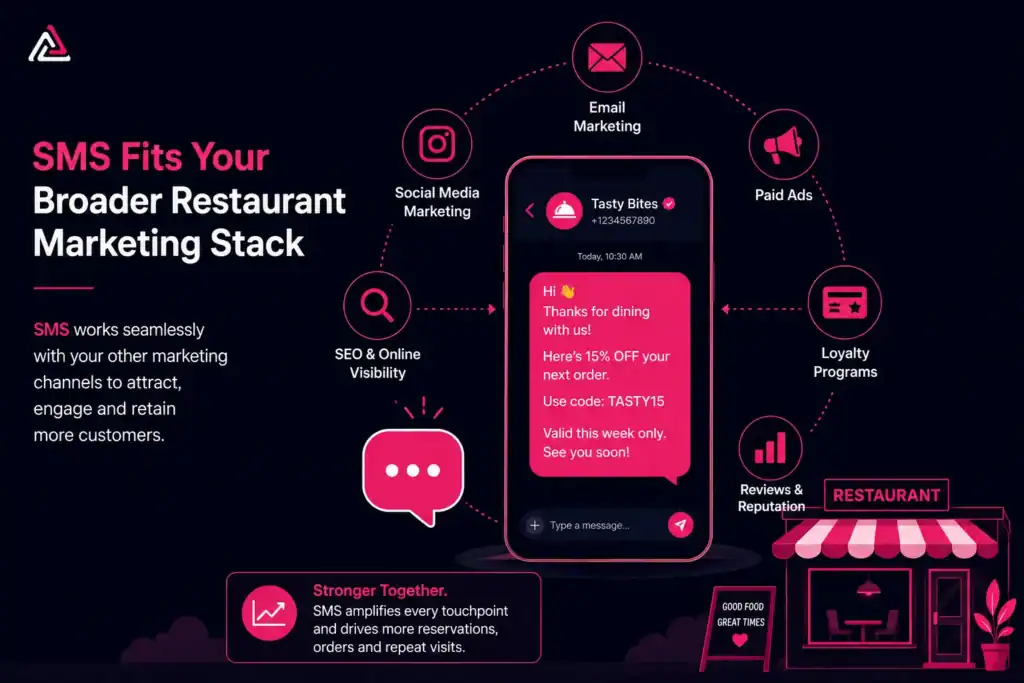
How SMS Fits Your Broader Restaurant Marketing Stack
SMS doesn’t replace email, social, or your loyalty program. It works alongside them for the moments where speed matters most.
- Email: Good for newsletters, detailed event previews, longer-form storytelling, post-season recaps.
- SMS: Good for reservation confirmations, same-day urgency, loyalty triggers, post-visit recovery.
- Social: Good for brand building, menu photography, user-generated content.
- In-app / loyalty platform: Good for points tracking, tier management, deep personalization.
Restaurants that perform best with SMS treat it as the urgency channel. When timing matters within hours, send a text. When the goal is relationship-building over weeks, email and social carry the load.
Frequently Asked Questions
What is the average open rate for restaurant SMS marketing?
SMS messages achieve roughly 98% open rates, with most read within 3 minutes of delivery. Email averages around 20% open rates for restaurant marketing. That gap is why time-sensitive restaurant communications, including reservation reminders and same-day promos, perform significantly better via text than email.
How do I get customers to opt in to restaurant SMS?
The most effective collection points for restaurants are: a checkbox on your online reservation or order form, a QR code at the host stand or table with a clear value offer (like ‘Text JOIN to [number] for a free dessert’), your website footer or pop-up, and your loyalty sign-up flow. The opt-in offer matters. A tangible reward like a discount or free item converts far better than a generic ‘stay in the loop’ ask.
Do I need to comply with TCPA for restaurant text marketing?
Yes. TCPA applies to all commercial SMS sent to US customers, including restaurant marketing texts. You need documented written consent before sending, a clear opt-out mechanism in every message, and A2P 10DLC brand and campaign registration. Violations start at $500 per message and can reach $1,500 for willful non-compliance. A compliant SMS platform handles opt-out suppression automatically.
How often should restaurants text customers?
For most restaurant SMS programs, 2-4 messages per month per subscriber is the right frequency. Higher frequency works for highly segmented and relevant campaigns, like a dedicated happy hour list or an events-only audience. Watch your opt-out rate: anything consistently above 2% per campaign signals over-messaging or low relevance.
Can I use SMS for HubSpot restaurant workflows?
Yes. A native HubSpot SMS integration connects directly to HubSpot workflows so you can trigger reservation reminders, post-visit follow-ups, and loyalty rewards based on contact properties and deal stages. Every conversation logs back to the HubSpot contact timeline automatically. See how SMS automation works inside HubSpot for the full workflow breakdown.
What’s the difference between two-way SMS and broadcast texting for restaurants?
Broadcast texting sends a message to your list with no reply path. Two-way SMS lets guests respond, confirm reservations, ask questions, or engage in a real conversation. For restaurant operations specifically, two-way SMS is essential for reservation management because it creates an interactive confirmation flow rather than a one-way notification. Guests who can reply are more likely to show up.
Does restaurant SMS marketing work for multi-location brands?
Yes, and it works especially well because you can segment by location, send location-specific promos, and manage all conversations from a shared team inbox. A central SMS platform lets your marketing team set the strategy while each location manages its own replies and reservation confirmations.
Get 300+ SMS Templates
Enter your details to download the PDF instantly.
Download Started!
Your 300+ SMS Templates PDF is downloading now. If it didn’t start, click here.
Start Sending SMS From Your Restaurant’s CRM
If you’re already managing contacts in HubSpot, adding SMS takes one afternoon to set up. A two-way SMS platform connected natively to HubSpot means reservation reminders, loyalty triggers, and same-day promos all run from the same place your team already works, with every reply logged to the contact timeline automatically.Plans start at $99/month. See how it connects to your HubSpot at messageiq.io and run your first automated reservation reminder before the weekend rush.