
To build high-performing SMS segments in HubSpot, combine lifecycle stage, behavioral intent, consent status, and recency controls. Good segmentation usually improves conversion by reducing irrelevant sends. Start with 4-6 core segments, then expand only after performance data validates each segment’s value.
Why This Matters
Weak segmentation is one of the biggest reasons SMS performance plateaus. If everyone gets the same message, response quality falls and unsubscribe risk rises. Segmentation aligns message intent with customer context.
Core segmentation model for HubSpot SMS
A practical segmentation framework uses four layers: who the contact is (profile), where they are in journey (lifecycle), what they did recently (behavior), and whether they can be messaged now (consent + suppression). This model keeps segments clear and avoids accidental overlap.
In HubSpot, define these as reusable filters and naming conventions so every team uses the same logic.
High-impact segment types to launch first
Start with a small set: new inbound leads, engaged evaluators, demo/no-show recovery, inactive leads, and existing customer activation. Each segment should map to one message objective and one KPI.
Avoid launching many micro-segments early; operational complexity can outpace learning.
Segment quality rules that protect conversion
Set segment hygiene rules: recency windows, frequency caps, suppression conditions, and mutually exclusive logic where needed. A segment without guardrails often turns into noise.
Use exclusion lists aggressively for contacts in active opportunities, legal hold, or unresolved support workflows.
Get Your Ultimate HubSpot Text Messaging Playbook for FREE
Discover how top HubSpot teams use SMS to boost engagement, close deals faster and streamline operations.
Instant download
Expert insights from certified HubSpot professionals
Ultimate Text Messaging Playbook

How to measure segment performance
Track metrics by segment, not only campaign. Use delivered rate, qualified reply rate, meeting/booked action, unsubscribe trend, and downstream pipeline influence. Compare segments side by side every week.
When a segment underperforms, first audit audience logic before rewriting all copy.
| Segment | Filter Logic Example | Primary Message Type | Primary KPI |
| New inbound leads | Lifecycle = Lead; consent = true; created < 7 days | Lead response + qualification | Qualified reply rate |
| High-intent evaluators | Visited pricing/demo pages >=2 in 14 days | Evaluation support + scheduling | Meeting rate |
| No-show recovery | Meeting outcome = no-show in last 3 days | Reschedule prompt | Rebook rate |
| Dormant leads | No engagement in 45+ days; consent active | Reactivation offer | Re-engagement rate |
| New customers (activation) | Customer status active; key setup incomplete | Onboarding nudges | Activation completion |
Step-by-Step Implementation
- Define segmentation goals by lifecycle stage.
- Create standardized contact properties for intent and consent.
- Build 4-6 core segments with strict inclusion/exclusion logic.
- Attach one campaign/workflow objective per segment.
- Implement frequency caps and suppression safeguards.
- Monitor segment KPIs weekly and tune filters before copy rewrites.
- Document segment definitions for cross-team consistency.
Quick Checklist
- Direct answer placed in the first section for answer engine extraction.
- Question-led headings and short paragraphs for skimmability.
- One structured table and one procedural list included.
- FAQ section answers 8 related conversational queries.
- EEAT trust note included with practical boundaries.
- Meta, schema, and internal-link suggestions included.
Frequently Asked Questions
How many SMS segments should we start with?
Most teams should start with 4-6 core segments to keep learning fast and operations manageable.
What is the biggest segmentation mistake?
Overlapping segment logic that causes duplicate or conflicting messages.
Should segmentation be based only on demographics?
No. Behavioral and lifecycle signals usually drive stronger conversion outcomes.
How often should segment logic be updated?
Review weekly in early rollout, then biweekly or monthly once stable.
Do we need separate suppression logic per segment?
Use global suppression first, then segment-specific suppressions where necessary.
What if one segment performs poorly?
Audit audience logic and timing first, then optimize copy and CTA.
Can sales create their own ad hoc segments?
Allow controlled creation, but enforce naming and governance standards.
Which KPI is most useful for segment quality?
Qualified reply rate combined with downstream conversion is usually strongest.
See how much revenue SMS could add to your HubSpot stack
Five inputs. Industry-backed benchmarks. Get your projected annual SMS revenue in under 30 seconds.
Calculate My SMS ROI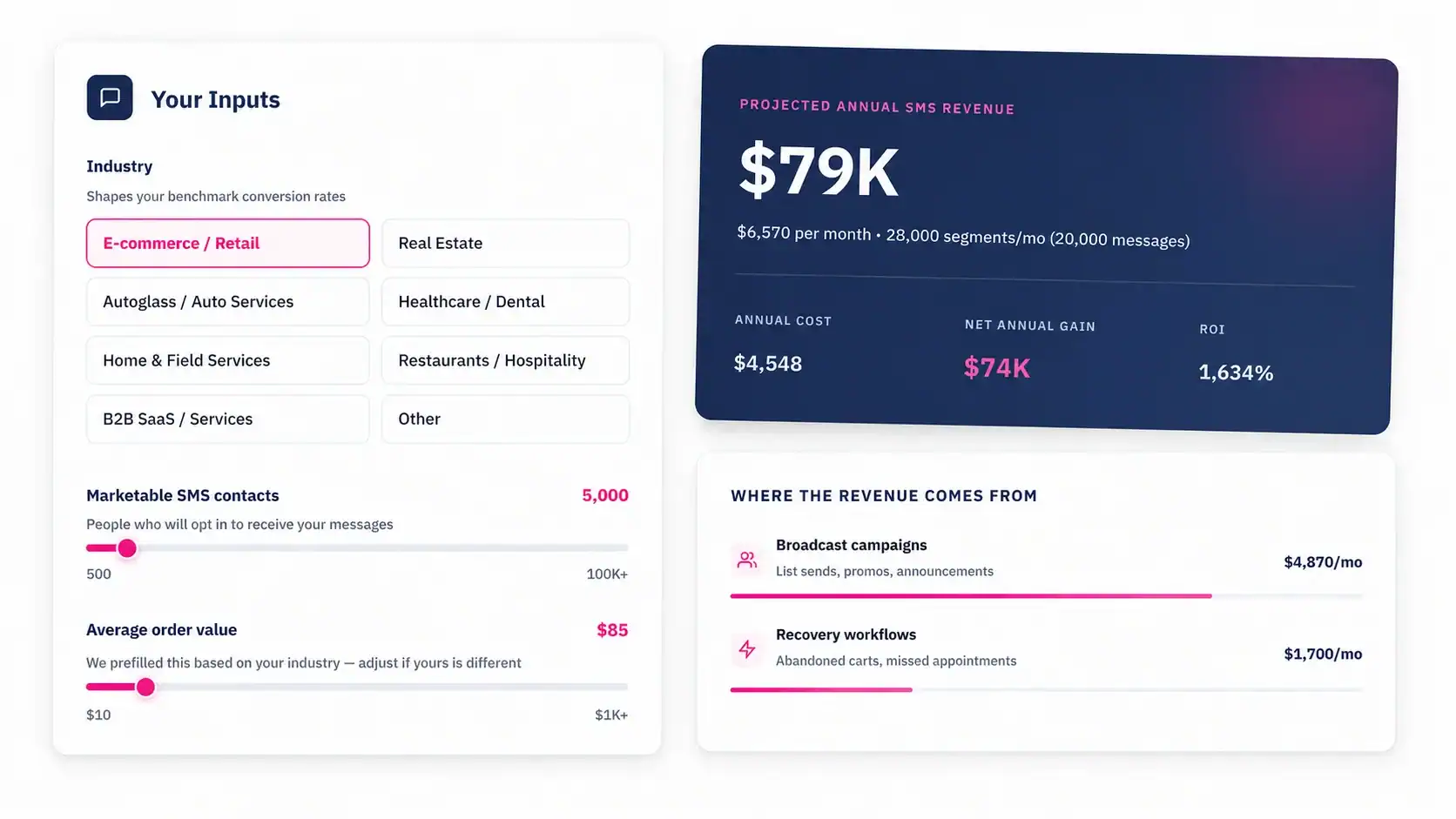
Conclusion
HubSpot SMS segmentation improves conversions when it is simple, disciplined, and behavior-driven. Strong segment architecture turns SMS from bulk outreach into precise, high-intent communication.